Florida's contractor license database is public, searchable, and updated in real time. Two minutes at myfloridalicense.com tells you everything about who's showing up at your door — license status, disciplinary history, insurance compliance. It's the step most Altamonte Springs homeowners skip because nobody mentioned it before the contractor arrived.
But a valid license is the floor — not the ceiling.
After years of working across ZIP codes 32701, 32714, 32716, and 32751, we've sat with a lot of homeowners who hired the wrong contractor before they found the right one. The problem is almost never a license issue. It's a process issue:
A system sized by tonnage matching instead of Manual J calculation
A permit that never got pulled — discovered at home inspection three years later
A Duke Energy rebate that expired because the Home Energy Check wasn't completed before installation
A system that was replaced but never actually improved
What we've learned from those conversations is this: the gap between a trustworthy contractor and an unreliable one rarely shows up in the quote. It shows up in what the contractor does — and doesn't do — before the first tool comes out of the truck.
Here's what this page gives you:
The verification step that should happen before any contractor enters your home
The single question that separates thorough contractors from careless ones
How to protect up to $3,000 in available incentives before installation begins
What a legitimate HVAC assessment looks like from start to finish
The post-installation questions most homeowners forget to ask until it's too late
Finding a trustworthy HVAC contractor isn't complicated. But planning top HVAC system replacement near Altamonte Springs FL requires knowing what to look for — and what to walk away from. Both are on this page.
TL;DR Quick Answers
How to Find a Trustworthy HVAC Contractor in Altamonte Springs FL
Finding a trustworthy HVAC contractor in Altamonte Springs starts with one step most homeowners skip — and ends with five questions most homeowners don't know to ask.
The step most homeowners skip:
Verify the contractor's license at myfloridalicense.com before the first conversation
Takes two minutes
Confirms license status, insurance compliance, disciplinary history, and permit authorization
Eliminates the most preventable category of contractor risk before anyone enters your home
The five questions that reveal everything about a contractor's process:
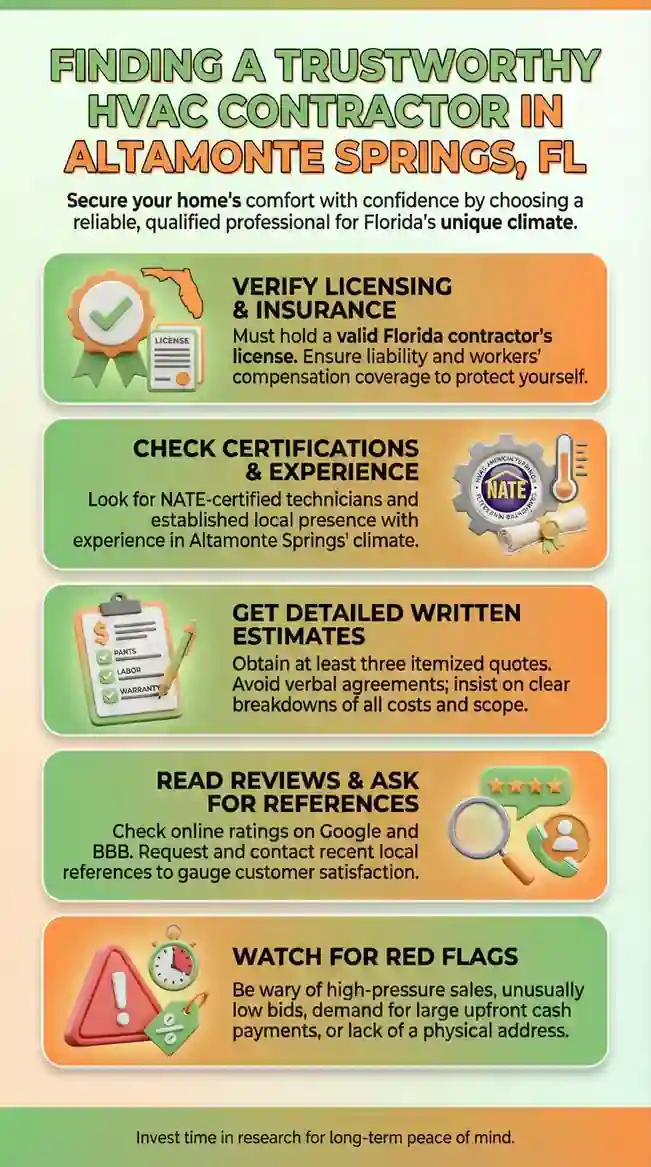
Will you perform a Manual J load calculation before recommending a system size?
Will you pull a permit for this installation — every time, no exceptions?
Will you walk me through the Duke Energy rebate qualification before scheduling work?
Does the equipment you're recommending qualify for the federal Section 25C tax credit?
What does post-installation support look like — specifically?
What trustworthy contractors do without being asked:
Perform Manual J — not tonnage matching — before recommending system size
Pull permits on every installation — required by Florida law, no exceptions
Address Duke Energy Home Energy Check requirement before scheduling installation
Confirm equipment meets ENERGY STAR thresholds for incentive eligibility
Provide clear post-installation support including permit inspection follow-up
Incentives currently available for Altamonte Springs homeowners:
Duke Energy rebate: up to $1,000 — Home Energy Check must be completed before installation
Federal Section 25C tax credit: up to $2,000 for qualifying heat pumps
Combined first-year offset: up to $3,000 — but only when the process is sequenced correctly
What the research confirms:
50 percent or more of residential HVAC systems aren't performing at rated efficiency — improper installation is a primary cause
Florida leads the country in contractor licensing complaints — unlicensed activity and permit violations top the list
6 in 10 U.S. homes have conditions negatively affecting indoor air quality — installation quality is the primary determinant
The bottom line: a trustworthy HVAC contractor makes license verification, Manual J calculation, permit compliance, and incentive guidance a standard part of the process — not an upgrade. The right contractor makes all of it easy. The wrong one makes you feel like you're asking too much when you do.
Top Takeaways
A valid license is the floor — not the ceiling. Verify it before anything else.
Florida's contractor license database is public, searchable, and updated in real time
Two minutes at myfloridalicense.com eliminates a risk category that surfaces years later — not day of installation
Homeowners most affected by unlicensed contractor activity almost never verified the license first
Skipping it removes the most basic protection available before anyone enters your home
The one question that reveals everything about a contractor's process: will you perform a Manual J calculation?
DOE documents 50 percent or more of residential HVAC systems aren't performing at rated efficiency
Improper sizing is one of the primary reasons
Tonnage matching replicates previous sizing errors — it doesn't correct them
Oversized systems short-cycle, fail to dehumidify, and produce Duke Energy bills that reflect none of the rated efficiency on the spec sheet
Ask for Manual J in the first conversation
Walk away from any contractor who can't explain why it matters
Up to $3,000 in first-year incentives is available — but only if the process is sequenced correctly.
Duke Energy rebate: up to $1,000 — Home Energy Check must be completed before installation
Federal Section 25C tax credit: up to $2,000 — equipment must meet ENERGY STAR certification thresholds
Both stack — neither reduces the other
DOE documents billions in available incentives go unclaimed annually because qualification wasn't explained before work was completed
A contractor who doesn't raise this conversation before scheduling installation is leaving up to $3,000 of your money unaddressed
Contractor selection is a family health decision — not just a financial one.
EPA documents 6 in 10 U.S. homes have conditions negatively affecting indoor air quality
HVAC installation quality is among the primary determinants of that outcome
In Central Florida homes running 10 to 11 months per year the connection is direct and consistent
What poor installation produces in this climate:
Oversized systems short-cycling — creating moisture conditions that drive mold
Duct leakage pulling unfiltered attic air into living spaces
Pressure imbalances drawing contaminants into conditioned areas
A system that was replaced but actively degrades the indoor environment it was installed to improve
The trustworthiness of a contractor reveals itself in the process — not the quote.
What a trustworthy contractor does without being asked:
Performs Manual J before recommending system size
Pulls every permit — no exceptions
Raises the rebate and tax credit conversation before scheduling installation
Assesses the duct system before recommending new equipment
Answers post-installation questions before you think to ask them
What the most expensive HVAC mistakes in Altamonte Springs have in common:
Started with a contractor who skipped the process — not bad equipment
Humidity still elevated six months after replacement
Duke Energy bill unchanged despite a new high-efficiency system
Mold returned to the same locations it was in before the replacement
The right contractor makes all of the above easy. The wrong one makes you feel like you're asking too much when you do. Knowing the difference before the decision is made — not after — is what this entire page is for.
The First Step Every Altamonte Springs Homeowner Should Take Before Hiring an HVAC Contractor
Verify the license. Before the quote. Before the consultation. Before anyone enters your home.
Florida's Department of Business and Professional Regulation maintains a public database of every licensed contractor in the state. It takes two minutes and reveals everything that matters before the first conversation:
Current license status and expiration date
Insurance compliance and coverage verification
Disciplinary actions, complaints, and license suspensions
Whether the contractor is legally authorized to pull permits in Florida
Why this matters in Altamonte Springs specifically: we've assessed homes where previous work was performed by unlicensed contractors. The pattern is consistent — no permits pulled, no inspections completed, and liability transferred entirely to the homeowner. That liability surfaces at the worst possible moment — during a home sale, an insurance claim, or a system failure that the warranty won't cover because the installation was never legal.
Verify first. Every time. No exceptions.
https://www.myfloridalicense.com/wl11.asp
The One Question That Tells You Everything About a Contractor's Approach
Ask every contractor the same question before discussing equipment, pricing, or timeline:
"Will you perform a Manual J load calculation before recommending a system size?"
The answer tells you more about a contractor's process than any review, rating, or referral.
What a Manual J calculation does:
Determines the precise heating and cooling load your home requires
Accounts for square footage, insulation, windows, orientation, duct condition, and local climate data
Produces a system size recommendation based on your home's actual needs — not the previous unit's tonnage
What happens without it:
System is oversized — short-cycles, never completes dehumidification, drives up the Duke Energy bill
System is undersized — runs continuously, never reaches comfort targets, wears prematurely
Humidity stays elevated regardless of which direction the sizing error goes
The efficiency rating on the spec sheet never materializes in actual performance
In our experience working across Altamonte Springs homes, oversizing is the most common sizing error we correct. It's almost always the result of tonnage matching — a contractor replicating the previous system's size without calculating whether that size was ever correct in the first place.
A contractor who can't explain what Manual J is, or who treats the question as unnecessary, is a contractor whose system recommendation you can't trust.
Why Permits Protect You — Not the Contractor
Every HVAC replacement in Florida requires a permit. This is state law. It is not optional, negotiable, or a formality that only applies to certain job types.
What the permit process actually does for the homeowner:
Ensures installation is inspected and verified against Florida Building Code
Protects homeowner's insurance coverage — unpermitted work is grounds for claim denial
Preserves the manufacturer's warranty on new equipment
Protects home resale value — unpermitted work surfaces at inspection and complicates closing
Establishes legal accountability for the installation
What we tell every homeowner about this:
If a contractor offers to skip the permit to save time, reduce cost, or simplify the process — that contractor is transferring their risk to you. The permit protects the homeowner. Skipping it benefits the contractor. Those two facts are worth holding onto when the conversation comes up.
Ask directly: will you pull a permit for this installation? The answer is either yes or it's a reason to end the conversation.
How to Protect Every Available Incentive Before Installation Begins
Up to $3,000 in first-year incentives is currently available for qualifying Altamonte Springs homeowners. Most of it goes unclaimed — not because homeowners aren't eligible, but because the process wasn't explained before the work was scheduled.
The incentive stack available right now:
Duke Energy Home Energy Improvement rebate: up to $1,000
Federal Section 25C tax credit: up to $2,000 for qualifying heat pumps
Combined first-year offset: up to $3,000 before a single lower Duke Energy bill is counted
The detail that costs homeowners the rebate most often:
The Duke Energy Home Energy Check must be completed before installation begins. Not the same week. Not retroactively. Before. A system that gets replaced before the check is completed disqualifies the homeowner from the rebate in most circumstances.
What a trustworthy contractor does with this information:
Walks you through the Home Energy Check requirement in the first consultation
Confirms equipment selection meets ENERGY STAR certification thresholds for tax credit eligibility
Sequences the process so incentives are protected before installation is scheduled
Doesn't treat rebate guidance as a bonus service — treats it as a standard part of doing the job correctly
A contractor who doesn't raise this conversation before scheduling work is leaving your money unaddressed. That's not a minor oversight — it's a process gap that costs homeowners up to $3,000.
What a Legitimate HVAC Assessment Looks Like From Start to Finish
A thorough contractor assessment in an Altamonte Springs home follows a consistent sequence. Knowing what that sequence looks like helps homeowners recognize when it's being skipped.
What a legitimate assessment includes:
Home walkthrough — every room, not just the equipment location. Airflow patterns, room-to-room temperature inconsistencies, and humidity levels tell the story before any panel is pulled.
Equipment evaluation — age, condition, refrigerant type, service history, and current performance against rated specifications.
Duct assessment — condition, leakage rate, insulation, and configuration. A system recommendation without duct evaluation is incomplete in any Central Florida home.
Manual J load calculation — performed on-site or with verified home data. Not estimated. Not assumed from previous system size.
Incentive review — Duke Energy rebate eligibility confirmed, Home Energy Check status verified, federal tax credit qualification discussed before equipment is recommended.
Written proposal — itemized equipment, labor, permits, and timeline. Not a verbal quote. Not a ballpark range.
What a shortcuts assessment looks like:
Contractor looks at the existing unit, asks the square footage, and recommends a replacement size
No duct evaluation
No Manual J mentioned
No rebate or tax credit discussion
Verbal quote with no itemization
The difference between those two assessments is the difference between a system that performs as promised and one that gets replaced without being improved — which is exactly what a quality HVAC replacement service prevents.
The Post-Installation Questions Most Homeowners Forget to Ask
The contractor conversation doesn't end at installation. The questions asked after the system goes in determine whether the investment is protected for the next ten to fifteen years.
Ask these before the technician leaves:
Who handles the permit inspection follow-up? The permit isn't closed until the inspection is completed. Confirm who schedules it, when it happens, and how you receive documentation.
What does the warranty cover — and for how long? Equipment warranty and labor warranty are separate. Understand both. Get it in writing.
What voids the warranty? Missed maintenance intervals, unauthorized service calls, and filter neglect are the most common warranty-voiding conditions we see. Know them upfront.
Is there a maintenance plan that protects the new system's performance? A new system without a maintenance plan is a long-term investment without protection. Annual maintenance preserves manufacturer warranty compliance, efficiency ratings, and system longevity.
Who do I call if something isn't right in the first 30 days? The answer to this question tells you whether you're working with a contractor who stands behind the installation — or one who moves on after the invoice is paid.
The contractors worth hiring in Altamonte Springs answer all five questions before you ask them. The ones worth walking away from make you feel like you're asking too much when you do.
"We've walked through a lot of Altamonte Springs homes after a contractor did the wrong thing. The story is almost never about a license problem or a bad product. It's about a process that was skipped — a Manual J that wasn't performed, a permit that wasn't pulled, a rebate conversation that never happened. What those homeowners have in common is that nothing about the contractor's quote or first impression signaled a problem. The gap showed up later — at the home inspection, on the Duke Energy bill, in the mold that came back six months after a system that was replaced but never actually sized correctly. The most expensive HVAC mistakes we see in this community aren't made by homeowners who didn't care. They're made by homeowners who weren't told what questions to ask before the work began."
Essential Resources
We've had a lot of conversations with neighbors in this community who wish they'd done a little more homework before the contractor arrived. Not complicated homework. Just the right homework. These are the seven resources we'd put in front of anyone we care about before they make this decision.
The Two-Minute Check We'd Tell Any Neighbor to Do First
Florida DBPR — Contractor License Verification
We live and work in this community — and we've seen what unlicensed work leaves behind. Two minutes on this tool before the first conversation protects you from a category of risk that surfaces years later, not the day of installation.
Confirms current license status and expiration date
Reveals disciplinary history and any complaints on record
Verifies insurance compliance before a quote is scheduled
Confirms the contractor is legally authorized to pull permits in Florida
https://www.myfloridalicense.com/wl11.asp
What Florida Law Requires — and Why It Protects You, Not the Contractor
Florida Building Code — HVAC Permit Requirements
Every HVAC replacement in Florida requires a permit. We pull one on every installation we complete — because we've seen what happens to homeowners when that step gets skipped. This resource explains exactly what's at stake.
Unpermitted work voids homeowner's insurance coverage
Unpermitted work surfaces at home inspection and complicates resale
Liability from unpermitted work transfers directly to the homeowner — not the contractor
Any contractor offering to skip the permit to save time is saving their time at your expense
The Standard That Tells You Whether a Contractor Is Sizing Your System — or Guessing
ACCA — Manual J Load Calculation Standard
After years of assessing homes across Altamonte Springs, the most common problem we correct is an oversized system installed without a load calculation. Understanding what Manual J is gives you the one question that separates a thorough contractor from a careless one.
Oversized systems short-cycle and never complete a full dehumidification cycle
Tonnage matching replicates previous sizing errors — it doesn't correct them
A contractor who can't explain Manual J is a contractor whose sizing recommendation can't be trusted
Correct sizing is the variable that determines whether a high-efficiency system actually delivers high-efficiency results
https://www.acca.org/technology/product/manual-j
The Step We Tell Every Neighbor to Take Before Scheduling Anything
Duke Energy Florida — Home Energy Improvement Program
This is the conversation we have with every Altamonte Springs homeowner before installation is scheduled — because missing this step costs up to $1,000 and it happens more often than it should. The Home Energy Check has to be completed before the new system goes in. Not after. Before.
Rebates up to $1,000 for qualifying HVAC replacements
Free Home Energy Check must be completed before installation begins
24-month window to complete qualifying improvements after the check is done
Planning ahead protects the rebate — emergency replacements create risk of missing it entirely
https://www.duke-energy.com/home/products/home-energy-improvement
How Your Neighbors Are Stacking a Federal Tax Credit on Top of the Utility Rebate
IRS — Energy Efficient Home Improvement Credit (Section 25C)
We walk every homeowner through this before equipment is selected — because the choice of system determines what you can claim. This is a direct credit against what you owe in federal taxes, and it stacks cleanly on top of whatever Duke Energy rebate you qualify for.
Up to $2,000 credit for qualifying heat pump installations
Stacks on top of Duke Energy rebates without reducing either
Labor costs for installation count toward the qualifying expense total
Equipment selection determines eligibility — review this before the contractor conversation, not after
https://www.irs.gov/credits-deductions/energy-efficient-home-improvement-credit
What a Contractor's Reputation Looks Like Beyond the License Database
Better Business Bureau — HVAC Contractor Search and Accreditation
A license confirms legal compliance. What it doesn't show is how a contractor handles a problem six months after installation — and that's the part that matters most to the families we serve in this community. This resource fills that gap.
Complaint history reveals how disputes are handled after the invoice is paid
Accreditation status reflects commitment to ethical business practices
Customer reviews surface patterns that license databases don't capture
Use alongside DBPR verification — not instead of it
Confirm the Equipment Recommendation Qualifies for Every Incentive Available
EPA — ENERGY STAR Contractor Locator and Certified Equipment
We recommend ENERGY STAR certified equipment on every qualifying installation — not because it's a marketing tier, but because it's the threshold that independently verifies efficiency claims and determines eligibility for both the federal tax credit and the Duke Energy rebate. This resource lets homeowners verify that for themselves.
Confirms equipment meets independently verified efficiency thresholds — not manufacturer self-reported claims
Identifies ENERGY STAR certified contractors serving the Altamonte Springs area
Validates equipment eligibility for federal tax credit and utility rebate qualification
Gives homeowners an independent verification tool that doesn't rely on contractor representations alone
https://www.energystar.gov/index.cfm?fuseaction=contractors.locator
Supporting Statistics
We've pulled a lot of panels in this community. We've measured static pressure, checked refrigerant charge, and walked duct systems in attics exceeding 130 degrees in July. The research below documents what we see in the field consistently across ZIP codes 32701, 32714, 32716, and 32751.
Why We Always Ask: Who Installed the Last System?
U.S. Department of Energy — Building Technologies Office
When a homeowner tells us their system was replaced two or three years ago but nothing feels different — this is the research that explains why.
The DOE documents that 50 percent or more of residential HVAC systems in the U.S. are not performing at their rated efficiency due to:
Improper installation
Incorrect sizing
Inadequate maintenance
What we find in homes that reflect this:
A 16 SEER2 system on the spec sheet delivering considerably less in practice
Refrigerant charge never verified against manufacturer specifications at startup
Airflow never measured or balanced across zones before the technician left
A duct system inherited by new equipment — never assessed
What separates replacements that worked from ones that didn't:
Manual J load calculation performed before equipment was selected
Duct system evaluated and repaired before installation
Refrigerant charge verified at startup — not assumed
Airflow measured and balanced before the job was called complete
The homeowners most frustrated after replacement aren't the ones who bought the wrong equipment. They're the ones whose contractor skipped the process that makes the right equipment actually perform.
Source: U.S. Department of Energy — Building Technologies Office https://www.energy.gov/eere/buildings/building-technologies-office
What Florida's Own Regulatory Data Tells Us About Contractor Risk in This State
Florida Department of Business and Professional Regulation — Licensee Search
Florida processes more contractor licensing complaints annually than nearly any other state regulatory body in the country.
The three most common violation categories filed against Florida HVAC contractors:
Unlicensed activity
Permit violations
Substandard work
What we've observed about homeowners most affected:
Almost none verified the contractor's license before work began
The problem didn't surface day of installation — it surfaced at home inspection, an insurance claim, or a warranty-voiding system failure
The two-minute verification at myfloridalicense.com was available to all of them before the contractor arrived
What the DBPR data confirms that our field experience reinforces:
License verification is a documented risk reduction step — not a formality
Florida's regulatory environment exists because the problem is significant enough to require it
Permit violations are among the most common complaints filed — and the most preventable
The homeowners who skip verification aren't careless — they just weren't told the step existed
We bring this up in every contractor evaluation conversation in this community. The risk is real. The step is simple. The two-minute check changes the outcome.
Source: Florida Department of Business and Professional Regulation — Licensee Search https://www.myfloridalicense.com/wl11.asp
Why the Money Left on the Table Is Almost Never the Homeowner's Fault
U.S. Department of Energy — Office of Energy Efficiency and Renewable Energy
The DOE documents that billions of dollars in available residential energy efficiency incentives go unclaimed annually — not because homeowners are ineligible, but because the qualification process wasn't explained before work was completed.
What we hear most often from homeowners who missed the incentives:
Nobody mentioned the Home Energy Check requirement before installation was scheduled
Equipment was recommended without discussing ENERGY STAR certification thresholds
The tax credit was discovered when filing taxes — months after optimal sequencing had closed
What the DOE research confirms:
Contractor guidance is the primary variable determining whether homeowners successfully claim available incentives
The pre-qualification process must be explained before work begins — not during or after
Up to $3,000 in combined first-year incentives is available now for qualifying Altamonte Springs homeowners
Homeowners who capture it are almost always the ones whose contractor raised the conversation first
We raise it in every consultation we conduct. Not because it's a differentiator. Because it's the right thing to do for a neighbor making a significant investment in their home.
Source: U.S. Department of Energy — Office of Energy Efficiency and Renewable Energy https://www.energy.gov/eere/office-energy-efficiency-renewable-energy
The Research That Reframes Contractor Selection as a Family Health Decision
U.S. Environmental Protection Agency — Indoor Air Quality
The EPA documents that approximately 6 in 10 U.S. homes have conditions that negatively affect indoor air quality. HVAC system performance is among the primary determinants of indoor air quality outcomes in residential settings.
In Central Florida homes — running 10 to 11 months per year with sealed building envelopes — this connection is direct and consistent.
What we find in Altamonte Springs homes where installation quality was poor:
Oversized systems short-cycling — never completing dehumidification, creating moisture conditions that drive mold
Duct leakage pulling unconditioned, unfiltered attic air into living spaces
Pressure imbalances from improper airflow drawing contaminants into conditioned areas
Recurring air quality complaints in homes with relatively new equipment — because the equipment was replaced but the installation problems weren't
What the EPA research frames that field experience reinforces:
Contractor selection is a direct determinant of the air quality a family breathes every day
A system replaced without duct assessment leaves the primary driver of air quality problems unaddressed
The difference between a system that protects air quality and one that degrades it is almost entirely determined by installation quality — not equipment brand, efficiency rating, or price
Homeowners who understand this ask better questions — and make better contractor decisions
The equipment matters. The contractor matters more.
Source: U.S. Environmental Protection Agency — Indoor Air Quality https://www.epa.gov/indoor-air-quality-iaq
These supporting statistics show why top HVAC system replacement is a smart upgrade, not just a swap—when it’s done with verified sizing, duct evaluation, airflow balancing, correct refrigerant charge, and proper compliance, the result is a system that truly delivers the efficiency, comfort, incentives, and healthier indoor air it was designed to provide.
Final Thought
Finding a trustworthy HVAC contractor isn't a complicated problem. But it requires asking a different set of questions than most homeowners know to ask — and knowing what the answers should sound like before the contractor arrives.
Most difficult situations we've encountered didn't start with a bad contractor. They started with a homeowner who had no framework for evaluating what good looked like.
The contractor seemed professional. The quote seemed reasonable. The system went in on schedule. Six months later — humidity still elevated, Duke Energy bill unchanged, nobody returning calls.
The research documents what we see firsthand:
50 percent or more of residential HVAC systems aren't performing at rated efficiency due to improper installation
Florida leads the country in contractor licensing complaints — unlicensed activity, permit violations, and substandard work top the list
Billions in energy efficiency incentives go unclaimed annually because the qualification process wasn't explained before work was completed
6 in 10 U.S. homes have conditions negatively affecting indoor air quality — and installation quality is the primary determinant of whether a new system improves that or compounds it
Here's the opinion we'd share with any neighbor making this decision:
The trustworthiness of an HVAC contractor doesn't reveal itself in the quote. It reveals itself in the process.
What a trustworthy contractor does without being asked:
Performs a Manual J calculation before recommending a system size
Pulls a permit on every installation — no exceptions
Raises the Duke Energy Home Energy Check requirement before scheduling work
Addresses federal tax credit eligibility before equipment is selected
Assesses the duct system before recommending new equipment
Answers post-installation questions before you think to ask them
None of those things are extraordinary. They're what doing the job correctly looks like.
What the homeowners in this community who made the best decisions had in common:
Verified the license before the first conversation — not after the quote was accepted
Asked about Manual J in the first call — walked away from contractors who couldn't answer it
Completed the Duke Energy Home Energy Check before installation was scheduled
Treated contractor selection as seriously as equipment selection
Understood that the efficiency rating on the spec sheet only materializes when the installation behind it is done correctly
One more thing worth saying directly:
The most expensive HVAC mistake we see in Altamonte Springs isn't buying the wrong equipment. It's hiring a contractor who installs the right equipment the wrong way — and discovering that six months later when:
Humidity is still elevated
The Duke Energy bill hasn't changed
Mold is back in the same corner it was before the replacement
That outcome isn't inevitable. It isn't even common among homeowners who know what to look for.
The framework for avoiding it:
Verify the license at myfloridalicense.com before anyone arrives
Ask for Manual J before any system size is recommended
Complete the Duke Energy Home Energy Check before installation is scheduled
Confirm equipment meets ENERGY STAR certification thresholds
Ask the five post-installation questions before the technician leaves
The right contractor makes all of that easy. The wrong one makes you feel like you're asking too much when you do.
That's the difference worth finding before the decision is made — not after.
FAQ on Finding a Trustworthy HVAC Contractor in Altamonte Springs FL
Q: How do I verify an HVAC contractor's license in Altamonte Springs FL?
A: Two minutes at myfloridalicense.com before the first conversation. It's the step most Altamonte Springs homeowners skip — and the one that eliminates more risk than any other single action in the contractor selection process.
How to verify before anyone arrives:
Go to myfloridalicense.com
Search by contractor name or license number
Confirm current license status and expiration date
Check for disciplinary actions, complaints, and suspensions
Verify insurance compliance and permit authorization
What a valid license confirms:
Contractor meets Florida's minimum legal requirements
Contractor carries required insurance coverage
Contractor is authorized to pull permits in Florida
No active disciplinary actions or suspensions on record
What a valid license doesn't tell you:
Whether Manual J load calculations are performed before sizing
Whether permits are pulled on every installation
Whether rebate qualification is addressed before work begins
Whether post-installation support exists after the invoice is paid
License verification is the floor. The process questions are the ceiling. Both matter — in that order.
Q: What questions should I ask an HVAC contractor before hiring them in Altamonte Springs?
A: These are the five questions that reveal more about a contractor's process than any review, rating, or referral.
Will you perform a Manual J load calculation before recommending a system size? A contractor who can't explain Manual J — or treats it as unnecessary — is a contractor whose sizing recommendation can't be trusted. Tonnage matching replicates previous errors. Manual J corrects them.
Will you pull a permit for this installation? Required by Florida law. No exceptions. Any contractor offering to skip it is transferring legal and financial risk directly to the homeowner.
Will you walk me through the Duke Energy rebate qualification before scheduling installation? The Home Energy Check must be completed before the system goes in. A contractor who doesn't raise this is leaving up to $1,000 unaddressed before a single tool comes out of the truck.
Does the equipment you're recommending qualify for the federal Section 25C tax credit? Equipment selection determines tax credit eligibility — up to $2,000. A contractor who selects equipment without addressing this is making a decision that affects your tax return without telling you.
What does post-installation support look like — specifically? Ask three things:
Who handles permit inspection follow-up?
What does the warranty cover and for how long?
Is there a maintenance plan protecting the new system's performance?
A contractor who answers without hesitation is a contractor who plans to be reachable after the invoice is paid.
Q: How do I know if an HVAC contractor pulled the required permits for my installation in Altamonte Springs?
A: Permit records in Florida are public. Verify before final payment — not after.
How to confirm a permit was pulled:
Contact Seminole County Building Division — records are publicly accessible
Search by property address — confirms permit status and inspection completion
Request permit documentation directly from the contractor
Verify the permit is open and inspection is scheduled before settling the invoice
What unpermitted work puts at risk:
Homeowner's insurance — unpermitted work is grounds for claim denial
Equipment warranty — installation must meet code to maintain validity
Home resale — unpermitted work surfaces at inspection and can derail closing
Legal liability — responsibility transfers to the homeowner, not the contractor
In our experience, homeowners who discover unpermitted work are almost never the ones who asked about it upfront. The question is easy to ask. What it protects is significant.
Q: What is a Manual J load calculation and why does it matter when hiring an HVAC contractor in Altamonte Springs?
A: Manual J is the industry-standard calculation that determines the precise system size a home actually requires. It's the single variable that determines whether a high-efficiency system delivers high-efficiency results — or just looks good on a spec sheet.
What Manual J accounts for:
Square footage, ceiling height, and floor plan configuration
Insulation levels in walls, attic, and floors
Window size, orientation, and glazing type
Duct condition, configuration, and leakage rate
Local climate data specific to Central Florida
What we find most often in Altamonte Springs homes:
Oversizing is the most common error — not undersizing
Most previous installations were sized by tonnage matching — replicating whatever was there before
Oversizing is almost always why humidity never resolved after the last replacement
Why oversizing matters:
Hits target temperature fast — shuts off before finishing dehumidification
Humidity stays elevated despite the system running
Short-cycling drives up Duke Energy bills regardless of efficiency rating
A correctly sized 16 SEER2 system consistently outperforms a poorly sized 20 SEER2 on every metric
Ask every contractor in the first conversation: will you perform a Manual J calculation before recommending a system size? The answer tells you everything about what the rest of the process will look like.
Q: How do I protect the Duke Energy rebate and federal tax credit when replacing my HVAC system in Altamonte Springs?
A: Both incentives require steps that must happen before installation begins — not after. This is the detail that costs Altamonte Springs homeowners up to $3,000 more often than it should.
The incentive stack currently available:
Duke Energy rebate: up to $1,000
Federal Section 25C tax credit: up to $2,000 for qualifying heat pumps
Combined first-year offset: up to $3,000
How to protect the Duke Energy rebate:
Schedule the free Home Energy Check before installation is scheduled
The check must be completed before — not after — the new system is installed
Once completed, 24 months to make qualifying improvements and claim the rebate
Emergency replacements have a 12-month retroactive window — planning ahead is always cleaner
How to protect the federal tax credit:
Confirm equipment meets ENERGY STAR certification thresholds before selection
Keep all receipts, manufacturer certifications, and contractor documentation
File IRS Form 5695 for the tax year the system is installed
Talk to a tax advisor before installation — equipment selection affects eligibility
What costs homeowners both incentives most often:
Contractor schedules installation without addressing qualification first
Home Energy Check window closes before it's completed
Equipment selected doesn't meet certification thresholds
Up to $3,000 disappears before a single lower Duke Energy bill is counted
A trustworthy contractor raises this conversation in the first consultation. If yours hasn't — ask directly. That question is worth exactly $3,000.
In How Do I Find a Trustworthy HVAC Contractor in Altamonte Springs FL?, one of the quickest ways to spot a contractor who prioritizes long-term performance is how they talk about airflow and filtration—not just the equipment sale. A trustworthy pro who sizes correctly and checks static pressure will also guide you toward the right ongoing maintenance choices, like a properly matched HVAC air filter replacement, a higher-capture MERV 13 HVAC air filter for stronger particle reduction, or a correctly sized 16x20x2 MERV 13 air filter that supports clean air without restricting airflow. These small, practical recommendations often reveal the bigger truth: the right contractor helps your system operate as designed long after installation day—protecting comfort, efficiency, and indoor air quality in Altamonte Springs.