TL;DR Quick Answers
top HVAC system replacement near Clermont FL
In our experience around Clermont, the top HVAC system replacement is the one with credentials you can verify yourself before any work starts:
Active Florida DBPR Class A or B Air Conditioning Contractor license
EPA Section 608 certified technician handling refrigerant
Lake County mechanical permit pulled before install
500-micron vacuum hold confirmed before refrigerant charge
AHRI matched-system paperwork in your file before the truck leaves
Top Takeaways
Most replacements wrap in 6 to 10 hours. Same-day swaps are the standard outcome unless ductwork or major electrical work is also on the scope.
The 500-micron vacuum held before refrigerant charge is the single most important quality checkpoint. Skip it and you're looking at a refrigerant leak inside five years.
Two credential checks are non-negotiable: EPA Section 608 certification for the technician handling refrigerant, and a current Florida DBPR Class A or Class B Air Conditioning Contractor license for the company.
Lake County permits and inspections are required on every residential HVAC replacement. The contractor pulls the permit before any equipment goes on the pad, and the county inspector comes by after the install.
AHRI matching documentation is what makes the manufacturer warranty real. Without that paperwork in your file, the 10-year parts warranty most homeowners assume they have isn't actually theirs.
The Week Before: Getting Your Clermont Home Ready
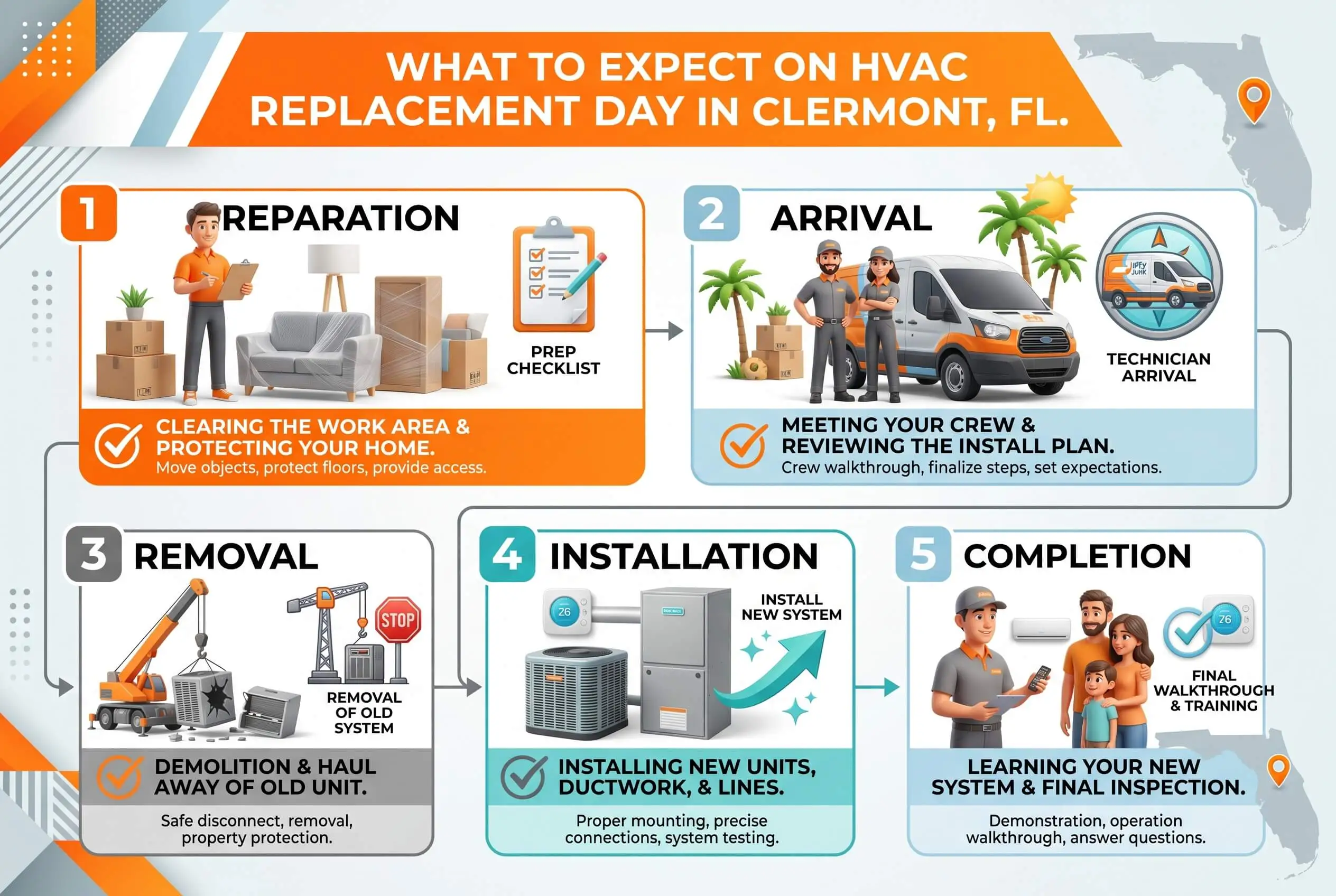
Most of what determines whether the day goes smoothly happens before we get there. We need clear paths to the condenser pad outside and the attic access inside. If either is blocked by stored boxes or holiday gear, plan to move it the evening before. Pets do best somewhere quiet during the loud morning hours, especially when refrigerant recovery is running. Master-planned communities like Kings Ridge, Heritage Hills, and Esplanade at Highland Ranch sometimes require a 48-hour HOA work notice or have rules about contractor parking, so check the email folder where those notices live. If you have AHRI matched-system paperwork from your existing equipment, set it on the kitchen counter for us. We'll use it to confirm capacity sizing before the truck rolls.
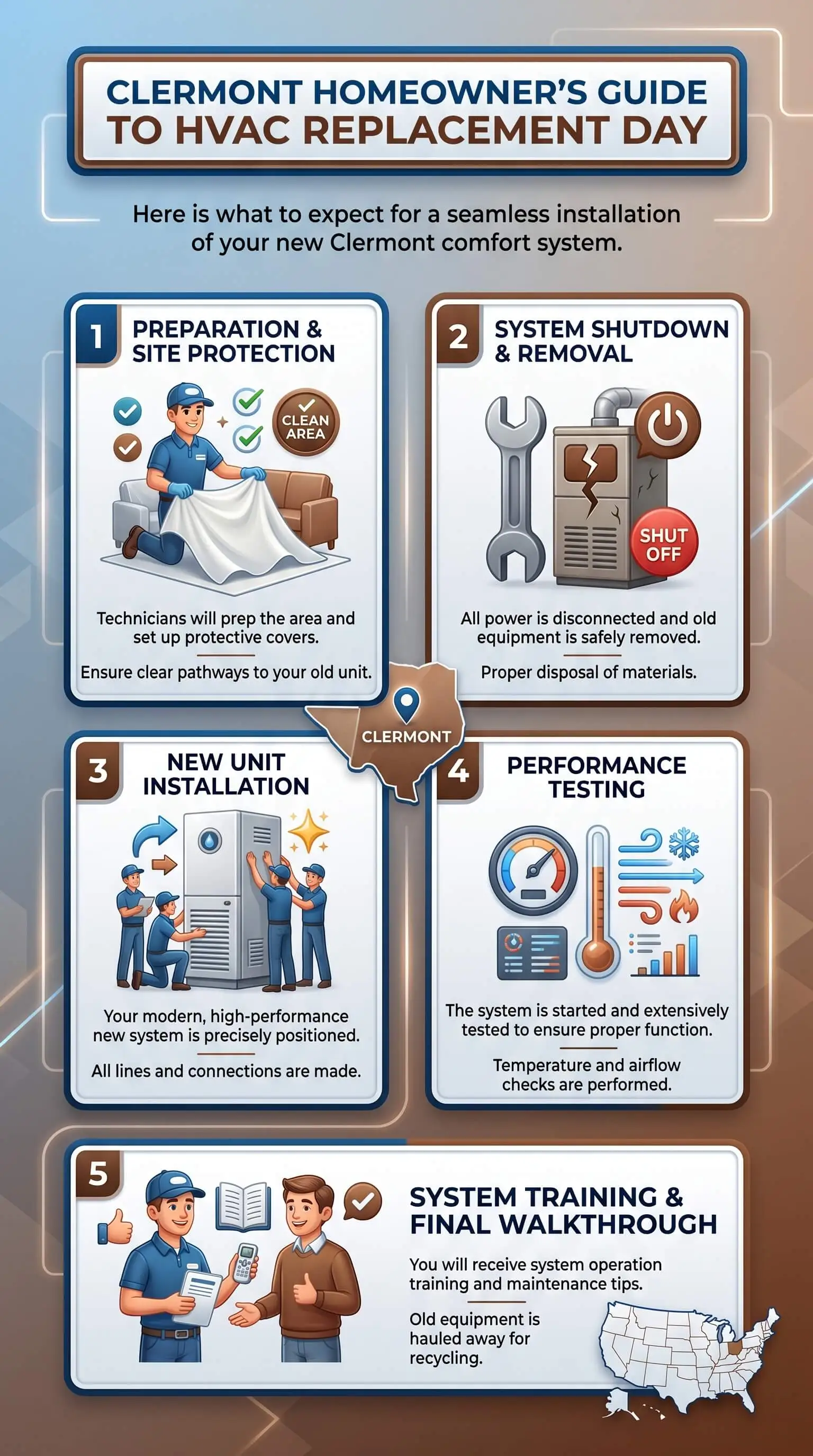
Morning Of: Arrival, Walkthrough, and Old System Removal
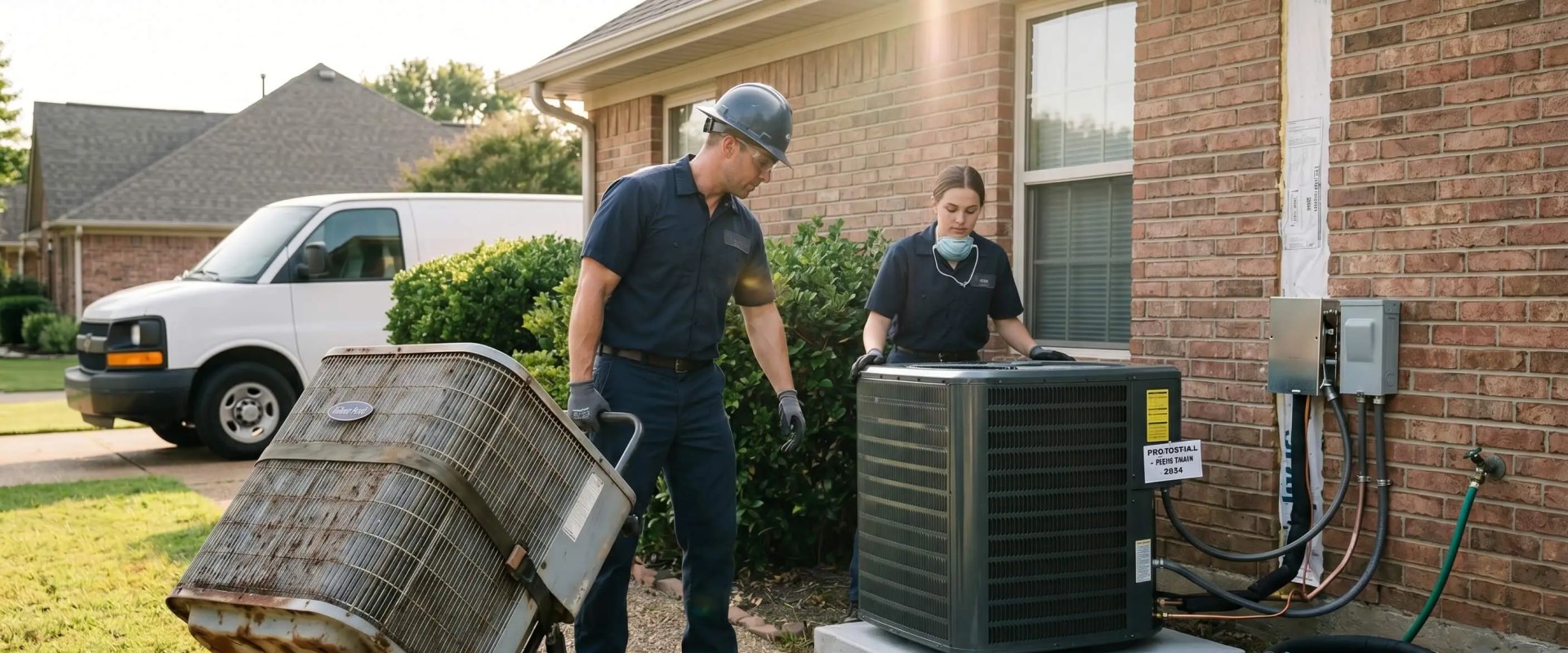
We typically arrive between 7:30 and 8:30 a.m. The early start matters because Central Florida attic temperatures climb past 130°F by lunch, and we want the heaviest physical work done before that. The first thing we do is walk through the home with whoever's there, confirm the scope of work, and put down floor protection from the entry through any interior work zones. After that, refrigerant recovery starts. EPA Section 608 rules require this step to be done by a certified technician with EPA-approved equipment before the old condenser comes off the pad. Removing the existing equipment, looking at the line set, and disconnecting the old air handler usually wraps up by mid-morning. If you want a quick primer on how the underlying heating, ventilation, and air conditioning system components fit together, that's a good moment to ask.
The Installation: What's Happening on the Pad and in the Attic
Once the old equipment is out, the new condenser sits on a level pad, the air handler positions inside, and we fabricate a transition plenum if the new equipment's dimensions don't match the old. They almost never do on systems older than ten years. We flush or replace the line set based on what the inspection turned up, then pressure-test with nitrogen to confirm there are no leaks. The vacuum step is the one we never shortcut. Pulling the system down to 500 microns and holding it there confirms the line set is dry and tight before we ever release refrigerant. Electrical work runs in parallel. We size the disconnect, verify the breaker, run low-voltage controls to the thermostat, and tie the condensate drain with float-switch into the new system.
Walkthrough and Done-Right Standard
Before we leave, the system runs for at least 20 minutes. We measure the supply-to-return temperature differential across the evaporator coil. A healthy split in Central Florida summer conditions lands between 18 and 22°F. Anything outside that range, we diagnose on the spot. That level of detail is what homeowners should expect from a professional HVAC replacement service focused on long-term system performance and reliability. The walkthrough covers thermostat operation, filter sizing and replacement schedule, condensate drain maintenance, and warranty registration. Most manufacturers require online registration within 60 to 90 days of installation for the full parts warranty to apply. Documentation handoff includes the AHRI certificate, the Lake County permit, and the inspection scheduling. Cleanup is part of the standard, not an extra. We pick up drop cloths, take the packaging with us, and leave the pad and attic the way we found them.
“Most of the systems we replace in Clermont came in with the homes between 2000 and 2010, which means we're working on equipment that's been running 130-degree attic summers for almost two decades. When we vacuum down to 500 microns and verify the AHRI match before starting the charge, we're catching what those years did to the line set. That five-minute test is where we either buy you the next 15 years of cooling, or we shortcut it.”
7 Essential Resources
Each of these is a primary source we use ourselves or recommend to homeowners researching a replacement. All links verified live as of this writing.
Heating, ventilation, and air conditioning (Wikipedia) — Plain-language overview of how the major components fit together: heaters, evaporator and condenser coils, refrigerant cycle, and ductwork. Good orientation if you want context before reading the rest.
EPA Section 608 Technician Certification Requirements — Federal certification standard for any technician handling refrigerant. Ask your contractor to show you the card. Certifications don't expire, but they're held by the individual, not the company.
EPA Technology Transitions: HFC Restrictions by Sector — Explains the 2025 transition from R-410A to lower-GWP refrigerants like R-454B and R-32 in new residential systems, including current sell-through provisions for existing equipment inventory.
U.S. Department of Energy: Heating and Cooling — DOE Energy Saver hub on home heating and cooling, including efficient cooling strategies for hot, humid climates, ductwork energy losses, and programmable thermostat guidance.
Florida DBPR Licensing Portal — License Search — Official Florida Department of Business and Professional Regulation lookup tool. Search by license number or company name. For HVAC work, look for an active Class A or Class B Air Conditioning Contractor license.
Lake County Building Services — County permitting authority for unincorporated Lake County. Residential mechanical permits and inspections for HVAC replacements run through this office. The contractor pulls the permit before any equipment goes on the pad, and the county schedules the inspection after the install.
HVAC System Replacement in Clermont, FL — Our parent service-area page covering scope, equipment options, and quote process for the top HVAC system replacement near Clermont, FL.
3 Statistics
Each statistic comes from a verified live .gov primary source and lands on what it means for a Clermont homeowner specifically.
Heating and cooling buildings accounts for roughly 35% of all energy consumption, the largest single share of any end use. (Source: U.S. Department of Energy.) In Central Florida, where the cooling season runs nine months out of twelve, that share climbs higher still. A properly sized and commissioned replacement is the single biggest energy decision most Clermont homeowners will make in any given decade.
A programmable thermostat used correctly can reduce heating and cooling costs by roughly 10% per year. (Source: U.S. Department of Energy.) Because Clermont's cooling load runs almost continuously from April through October, that 10% applies to a much larger annual bill than the national average. That's why we work the thermostat commissioning into the standard walkthrough rather than treating it as an afterthought.
Clermont's population sits around 44,301 today, per the Bureau of Economic and Business Research, up from roughly 9,000 in 2000. (Source: City of Clermont Demographics.) That growth pattern explains why most of the replacement-age systems we see today went into homes during the 2000s housing boom. We're servicing equipment that builders installed when Clermont was a quarter the size it is now.
These statistics highlight why Clermont homeowners are paying closer attention to the best HVAC system replacement options, especially as rising energy demands, long Florida cooling seasons, and aging systems from the early 2000s continue to impact comfort, efficiency, and monthly utility costs across the area.
Final Thoughts and Opinion
A one-day install is a standard job, but it's also one of the bigger transactions a homeowner makes in any given decade. Knowing what's normal versus what's a red flag is what turns "they finished" into "they did it right." If we're working in your home and something feels off, a step skipped or a question dodged, say something on the spot. We'd rather pause for five minutes and walk you through what's happening than answer the same question two weeks later when warranty paperwork arrives and something doesn't line up.
Frequently Asked Questions
How long does a typical HVAC replacement take in Clermont, FL?
A like-for-like single-day swap usually takes 6 to 10 hours start to finish. That window covers refrigerant recovery, old-equipment removal, new condenser and air-handler placement, the vacuum and pressure test, the refrigerant charge, and final commissioning. Jobs that involve ductwork changes, electrical service upgrades, or attic-platform rebuilds typically run two days.
Do I need to be home during the entire installation?
We need a homeowner present at the morning walkthrough and again at final system commissioning. Most clients work from home or pop in midday. If you can't be there, designate someone with authority to make scope decisions in case we find something unexpected once the old equipment is out.
What's the difference between a like-for-like swap and a full system upgrade?
A like-for-like swap matches the new system's tonnage, voltage, and configuration to whatever was already there. An upgrade changes capacity, efficiency tier, or fuel type instead. Capacity changes start with a Manual J load calculation. Efficiency is measured today as SEER2. Upgrades usually need additional electrical work and sometimes ductwork modifications.
Will my old ductwork need to be replaced too?
Often no, sometimes yes. Most Clermont homes built between 2000 and 2010 have flex ducts that's still serviceable but worth a look for collapse, disconnection at the boots, or heavy dust load. We test static pressure on every replacement and only recommend duct work when the numbers tell us to.
How does the 2025 R-454B refrigerant transition affect my replacement?
New residential AC and heat pump systems manufactured starting January 1, 2025 use lower-GWP refrigerants like R-454B instead of R-410A. EPA has issued sell-through provisions that let installers keep using existing R-410A inventory during the transition. Whichever refrigerant your new system carries, the technician handling it must hold a current EPA Section 608 certification.
What permits and inspections are required in Lake County?
Before any equipment goes on the pad, the contractor pulls a residential mechanical permit through Lake County Building Services. After the install, the county schedules a mechanical inspection. The contractor meets the inspector. The permit and inspection record stays with the property and can surface on future title searches and insurance reviews.
How do I verify my HVAC contractor's Florida license?
Use the Florida DBPR license search and look for a current Class A or Class B Air Conditioning Contractor license. Class A is unlimited. Class B covers systems up to 25 tons cooling and 500,000 BTU heating, which covers nearly all residential work. Confirm the license reads "Active" and that the licensee name matches the company name on your quote.
Planning Replacement Day at Your Clermont Home
A walkthrough estimate from the top HVAC system replacement near Clermont, FL puts the schedule, the scope, and the paperwork in front of you before we order any equipment. We'll come look, tell you honestly what we'd do if it were our own home, and leave you with what you need to decide on your own timeline.
In How to Choose the Best HVAC Contractor in Clermont for a System Replacement, we explain why the best contractors focus on more than just installing equipment — they also help homeowners protect system efficiency and indoor air quality long after installation day. One of the simplest ways to extend the life of a newly installed system is by using quality filtration products like 20x24x1 dust defense replacement filters, 20x20x1 MERV 11 HVAC air filters, or pleated AC furnace replacement filters. Proper filter maintenance helps reduce airflow restrictions, supports healthier indoor air, and keeps replacement systems running more efficiently during Clermont’s long cooling season.