A narrow set of homeowners can absolutely handle this themselves. If the motor is a PSC type, the air handler sits within easy reach, the system is out of warranty, and you've worked with 120V or 240V circuits before, the swap is feasible. The trouble is that most homeowners only check two or three of those boxes, and the gap between two and four is where this repair goes sideways.
TL;DR Quick Answers
blower motor replacement cost
Across the calls we run, blower motor replacement cost lands between $300 and $900 total, parts and labor combined. PSC motors sit at the lower end. ECM and variable-speed motors push higher, especially when the job calls for a programmed motor-and-module assembly. Accessibility and diagnosis time move the final number from there.
Typical range: $300–$900 total, parts and labor.
PSC motors: $50–$250 for the part. A DIYer with electrical experience can swap one in an afternoon.
ECM motors: $350–$1,150 for the assembly. Many need system-specific programming during install.
What drives a higher quote: ECM motor type, attic or tight-closet installs, related parts like a capacitor or control module, or emergency service.
Top Takeaways
Most blower motor replacements run $300 to $900 total. Motor type drives the spread.
PSC motors are mechanically simpler and cheaper to replace. ECM motors often need programming and matched assemblies.
Confirm the diagnosis before authorizing the repair. A weak capacitor or failed control board can mimic motor failure.
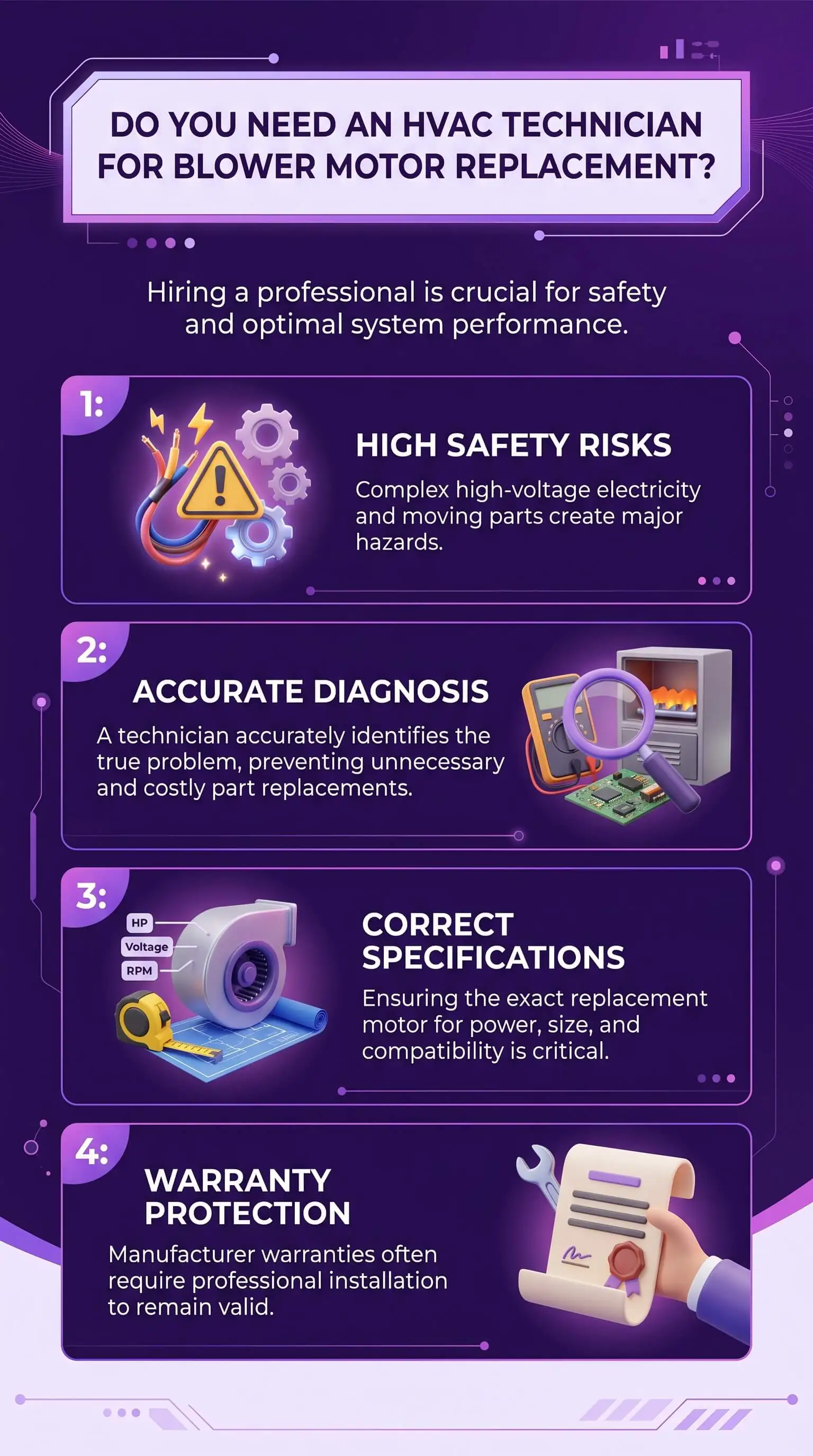
DIY replacement on a system under manufacturer warranty commonly voids parts coverage on the entire unit, not just the motor.
Capacitor discharge stands as the most common DIY injury point on this repair, and most homeowners underestimate it.
What the Blower Motor Actually Does
The blower motor drives air across the heat exchanger and pushes it through the ducts into your living spaces. Without it, the gas burners can still ignite, but no heat reaches the rooms. The same blower commonly serves both the furnace and the central air conditioner, so a failed blower in October usually signals a failed cooling system come June if nobody catches it. For a deeper look at how the blower fits inside the larger heating appliance, the central heating furnace overview covers the engineering history and the different efficiency classes.
Signs the Blower Motor Is Failing
Five symptoms come up most often on our service calls:
Weak airflow from the registers, even though the system seems to be running.
Rumbling or grinding noises when the system starts up.
The fan cycles on and off without the blower ever spinning up.
A burning electrical smell coming through the supply vents.
Intermittent shutoffs followed by the system trying to restart on its own.
Here's the part nobody likes to hear: every one of these symptoms can also point to furnace filters that need attention, a weak run capacitor, or a failed control board. A motor swap fixes none of those. Confirming the diagnosis before authorizing the repair is the single biggest thing separating a $400 invoice from a $1,200 callback.
The Real Question: DIY or Hire It Out?
We use a four-question decision tree ourselves when a neighbor asks. Run through these:
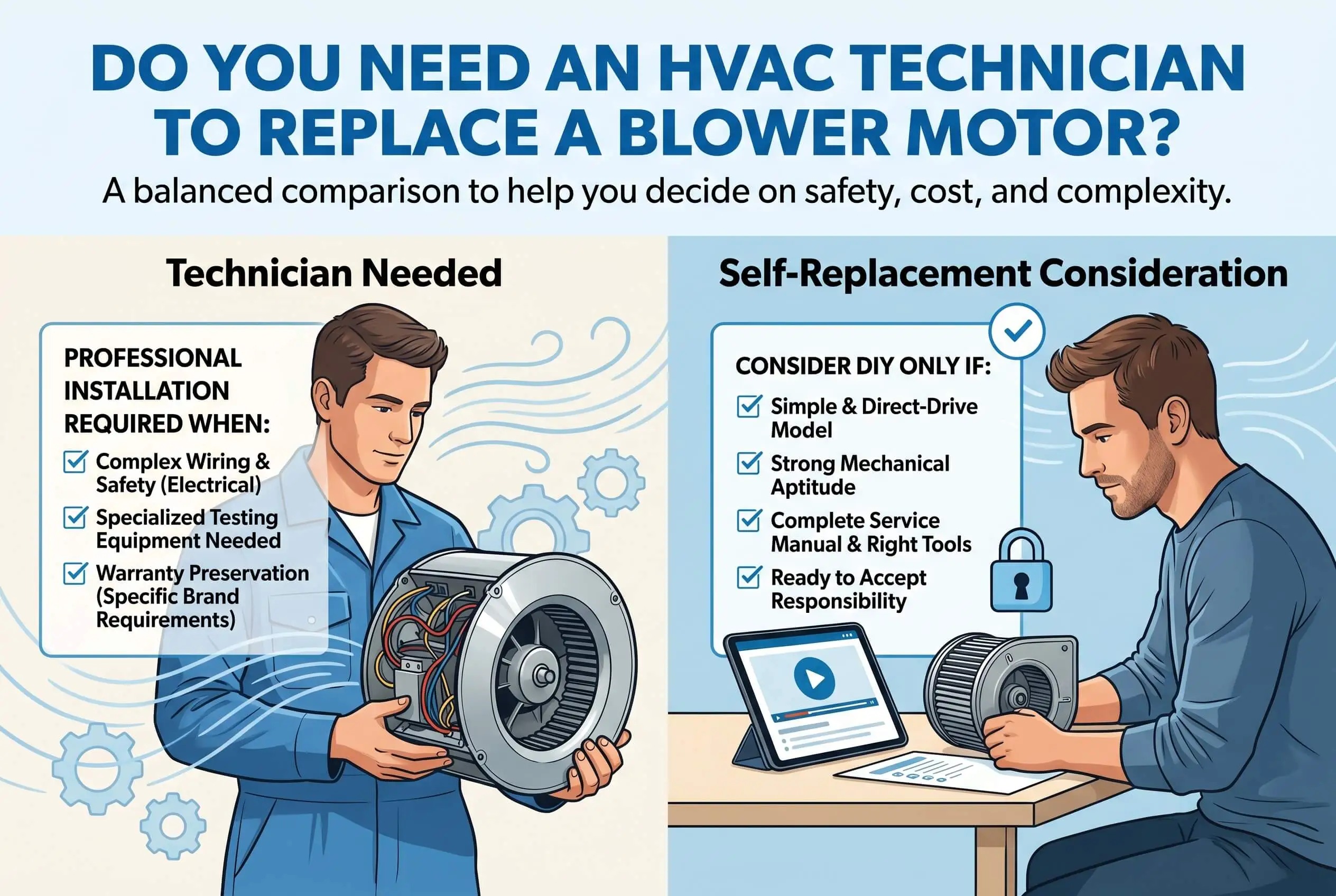
Is the motor a PSC (Permanent Split Capacitor) or an ECM (Electronically Commutated Motor)? PSC swaps are mechanically straightforward. ECM jobs often require programming or a matched motor-and-module assembly, which sits outside the range of a typical DIY workshop.
Is the air handler accessible, or buried in an attic or tight mechanical closet? Attic installs in Florida hit cabinet temperatures north of 130°F in summer, and the wiring is rarely friendly to first-time hands.
Is the furnace still under manufacturer warranty? Most warranties from Carrier, Trane, Lennox, Goodman, and Rheem require professional installation by a licensed contractor to remain valid on the rest of the unit, not just the motor.
Have you worked with 120V or 240V circuits before? The run capacitor on a PSC system can hold a lethal charge for days after power-down. The discharge procedure isn't complicated for trained techs, but it remains the most common DIY injury point we hear about.
If you answered "PSC, accessible, out-of-warranty, and yes" across the board, a DIY swap is feasible with the right tools and a service manual. If even one answer goes the other way, you're better off calling someone.
PSC vs ECM Motors Change the Answer
This is the variable most cost guides skip, and it drives the spread between a $350 invoice and an $1,100 invoice.
PSC (Permanent Split Capacitor) Motors
PSC motors show up in older and basic systems. They run at one or a few fixed speeds, rely on a separate run capacitor to start and run, and cost less to source. Most parts land between $50 and $250. The wiring is straightforward, and a DIYer with electrical experience can swap one in an afternoon. Just don't skip the capacitor. If the existing one tests weak, replace it at the same time. A failing capacitor stresses the new motor and undoes the repair within a season.
ECM (Electronically Commutated Motor) Motors
ECMs show up in most newer high-efficiency systems. They use electronic control to vary speed and maintain consistent airflow, which is part of why a system rated for variable-speed comfort actually delivers it. The trade-off is replacement cost. ECM parts run $350 to $1,150 or more, and many ship as a motor-plus-module assembly that needs system-specific programming. ENERGY STAR's furnace efficiency guidance notes that the high-efficiency systems where most ECMs operate deliver meaningful annual energy savings over older fixed-speed designs. The higher upfront cost recovers over time on the utility bill.
What Blower Motor Replacement Actually Costs
Across the service calls we've worked, blower motor replacement cost lands in a band most homeowners can plan around, assuming the diagnosis is correct and no surprise parts surface during the call.
Typical total, parts and labor: $300 to $900 for most residential replacements.
Motor part alone: $50 to $250 for a PSC. $350 to $1,150 for an ECM or programmed assembly.
Labor: $150 to $400, usually 1 to 2 hours of work plus diagnosis time.
Emergency or after-hours service: add $100 to $200 to the labor line.
When a quote sits outside that band, the spread usually comes from motor type, accessibility, or extra parts the tech finds during the call. ECM motors sit at the top end. Attic and tight-closet installs add labor time. A weak capacitor, a control module, fresh mounting hardware, or wiring repair can each push the invoice up on the day. For the deeper breakdown on how parts, labor, warranty coverage, motor type, and furnace replacement cost considerations combine into your final number, this furnace blower motor replacement cost guide from Filterbuy walks through each variable with the questions worth asking before authorizing the work.
Warranty Considerations Most DIYers Miss
Manufacturer warranties from Carrier, Trane, Lennox, Goodman, and Rheem typically require professional installation by a licensed contractor to stay valid. When a homeowner swaps in a motor themselves, the manufacturer can void parts coverage on the rest of the unit, not just the motor. That's a several-thousand-dollar exposure on a system that might still carry five or seven years of coverage left.
Even when the warranty covers parts, labor usually comes separately. Most manufacturer parts warranties don't pay for the technician's time unless the homeowner bought an extended labor plan at installation. Before approving any quote, ask these out loud:
Is the blower motor covered under my manufacturer parts warranty?
Does that coverage include labor, or am I paying out of pocket for the technician's time?
Will you handle the warranty claim paperwork, or do I need to file it myself?
Safety Risks We Take Seriously
We're not in the business of catastrophizing. Most furnace repairs go fine. A few risks deserve naming plainly, because they show up in the data and not just in marketing copy:
Capacitor discharge. PSC capacitors hold high voltage for days after the breaker flips off. Improper handling stands as the most common DIY injury point on this repair.
Wrong motor pairing. Wrong rotation direction, wrong horsepower rating, or wrong speed-tap selection causes overheating, reduced airflow, and accelerated failure of the new motor. The original equipment specs matter.
Combustion safety on gas systems. Improper blower operation can lead to incomplete combustion, heat exchanger stress, and in rare cases carbon monoxide concerns. The NFPA tracks heating-equipment-related home fires annually, and we cite the numbers in the statistics section below.
"The motor swap itself is the simple part. What separates a $400 invoice from a $1,200 callback six weeks later is whether the technician actually diagnoses why the motor failed in the first place, and then fixes the root cause. I've replaced too many blower motors that came out again a year later because nobody addressed the restricted airflow or the weak capacitor that killed the first one. A correct diagnosis is the cheapest part of the bill. Skipping it is the most expensive."
7 Essential Resources
When we hand off a repair recommendation, we want homeowners to verify what we said against the same primary sources we use. These seven sit at the top of our list:
US Department of Energy: Furnaces and Boilers. Plain-English consumer guidance on AFUE ratings, heating system efficiency categories, and replacement decision factors. energy.gov/energysaver/furnaces-and-boilers
ENERGY STAR Certified Furnaces. The EPA's certified product list and efficiency criteria for residential furnaces, including the ECM blower performance benchmarks. energystar.gov/products/heating_cooling/furnaces
NFPA Home Heating Fires Data. Annual statistical reports on residential heating equipment fires, causes, and prevention. Useful context for weighing professional installation against DIY. nfpa.org heating equipment safety
ESFI Home Electrical Safety. The Electrical Safety Foundation International's homeowner resources covering electrical hazards, capacitor safety, and when to hire a licensed electrician or HVAC professional. esfi.org/home-safety
US Bureau of Labor Statistics: HVAC Mechanics and Installers. Occupational data, median wage, job projections, and credentialing pathways for licensed HVAC technicians. Helpful when sanity-checking labor quotes. bls.gov HVAC occupational outlook
NATE (North American Technician Excellence). The nation's largest non-profit HVAC certification body. Use the site to verify a technician's NATE credentials before they touch your system. natex.org
EPA Section 608 Technician Certification. The federal requirement for HVAC techs who handle refrigerants. Relevant context when your blower failure is part of a larger combined heating-and-cooling system service. epa.gov/section608
3 Statistics
Numbers from primary sources, each tied to a claim we made above:
38,881 home heating equipment fires per year. From 2019 through 2023, U.S. fire departments responded to an annual average of 38,881 home heating equipment fires, resulting in 432 civilian deaths, 1,352 injuries, and $1.1 billion in property damage, according to the National Fire Protection Association. That number stands behind the safety case for getting heating-system repairs right the first time. Source: NFPA, Home Heating Fires (2019–2023 data)
$59,810 median annual wage for HVAC technicians. The US Bureau of Labor Statistics reported a median annual wage of $59,810 for heating, air conditioning, and refrigeration mechanics and installers in May 2024, with the field projected to grow 8% between 2024 and 2034, much faster than the average across all occupations. The labor portion of your repair quote reflects training, certification, and experience that takes years to develop. Source: BLS Occupational Outlook Handbook, HVAC Mechanics
Up to 15% efficiency gain from ENERGY STAR–certified furnaces. ENERGY STAR–qualified furnaces, where most modern ECM blowers live, can run up to 15% more efficiently than standard models. That's part of why the higher replacement cost on an ECM motor often recovers over time on the utility bill. Source: ENERGY STAR Furnaces program criteria
Final Thoughts and Opinion
Our honest take: most homeowners reading this should call a licensed technician. The math is straightforward. Voiding a manufacturer warranty, mishandling a capacitor, or installing the wrong motor type each costs more than the labor you'd save by going it alone. The exceptions live where the conditions actually line up: older PSC systems, out-of-warranty units, accessible installs, and electrical experience that goes beyond changing a light fixture. We respect homeowners who do their own work when all four boxes check. Just make sure they all check before the breaker comes off.
Frequently Asked Questions
How much does blower motor replacement cost?
Most replacements fall between $300 and $900 total, including parts and labor. Simpler PSC swaps on accessible systems land closer to $300. ECM replacements on variable-speed systems often run $700 to $1,200 or higher when the job calls for a programmed motor-and-module assembly.
Can I replace a blower motor myself without voiding the warranty?
Usually no. Most major manufacturer warranties from Carrier, Trane, Lennox, Goodman, and Rheem require professional installation by a licensed contractor to stay valid. DIY replacement on a system still under warranty typically voids parts coverage on the rest of the unit, not just the motor. Check the specific warranty terms before deciding.
How do I know if it's the motor or the capacitor that failed?
On PSC systems especially, a weak capacitor can mimic motor failure. The symptoms overlap heavily. Humming, slow startup, and intermittent operation can all point to either failure. A technician should test the capacitor with a multimeter before authorizing motor replacement. If a tech quotes you for motor replacement without that test on a PSC system, ask for one.
Is an ECM blower motor worth the higher replacement cost?
If your system shipped with variable-speed capability, yes. Swapping in a PSC equivalent throws away the comfort and efficiency the manufacturer designed around the ECM. If your system has always run a PSC, we don't usually recommend the upgrade unless you're doing a larger renovation. Match the replacement to the manufacturer's original spec.
How long does a furnace blower motor last?
A well-maintained blower motor typically lasts 10 to 20 years. Climate matters. In Central Florida attic installs that hit 130°F-plus in summer, we see bearings wear out closer to the lower end of that range. Regular filter changes and yearly maintenance significantly extend motor life by keeping airflow consistent and reducing strain on the system.
What should I expect during a blower motor service call?
A proper call includes diagnostic testing, safe power shutoff and disassembly, motor removal and replacement with matched specifications, wiring and rotation verification, and a full airflow test before the tech leaves. Diagnostic testing means a multimeter check, capacitor testing, and control board verification. If a quote skips the diagnostic step, that's the first thing to ask about.
Before You Authorize That Blower Motor Repair
If the quote already sits in front of you and the numbers feel off, take ten minutes with the cost breakdown linked above before you sign anything or start considering a top HVAC replacement. Knowing which questions to ask the technician separates a fair price from an avoidable surcharge.
In an article about Do You Need an HVAC Technician to Replace a Blower Motor?, it helps to frame the technician’s role around more than the motor swap itself, because a proper diagnosis should also consider whether restricted airflow contributed to the failure. Products like 16x20x1 furnace filters, 10x30x1 HVAC air filters, and 20x30x2 furnace filters fit naturally into that conversation, since the right filter size and MERV rating can help maintain cleaner airflow, reduce strain on the blower motor, and give the HVAC technician a better baseline when testing the system after the repair.