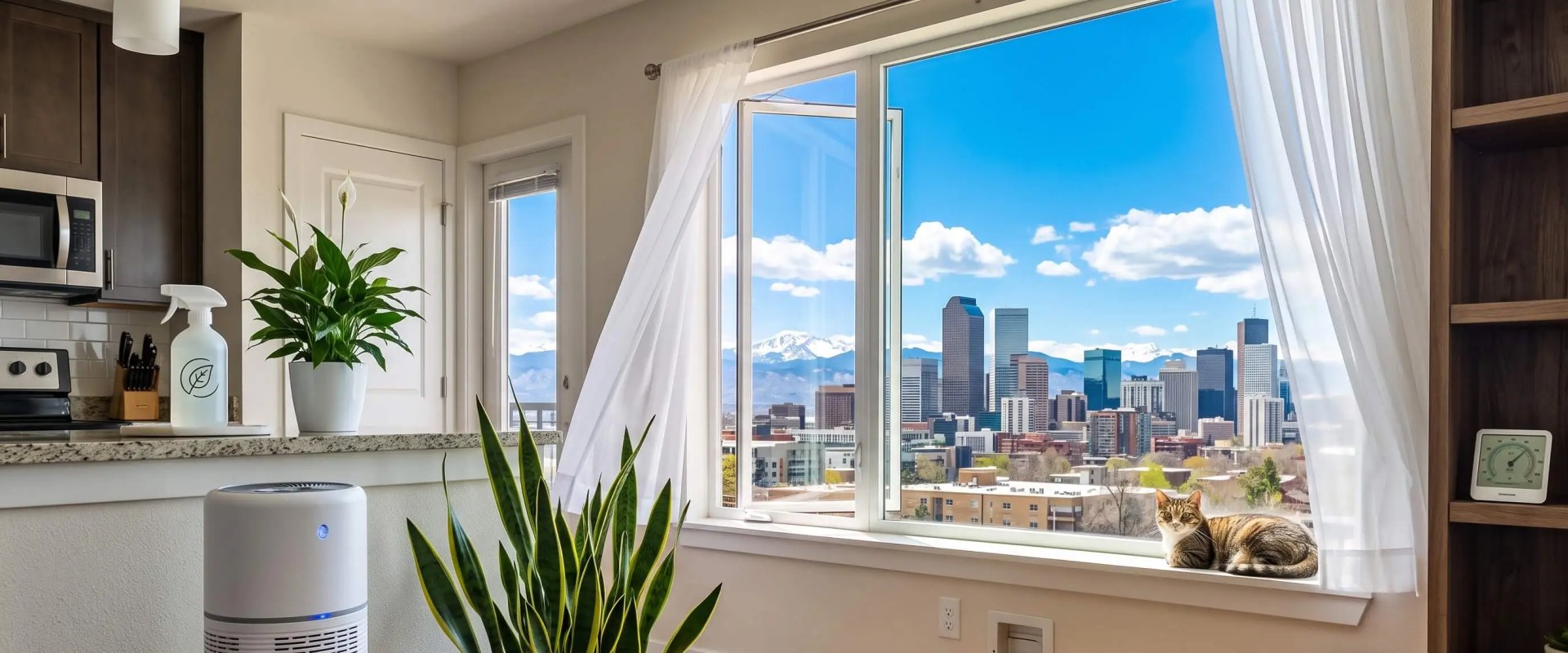
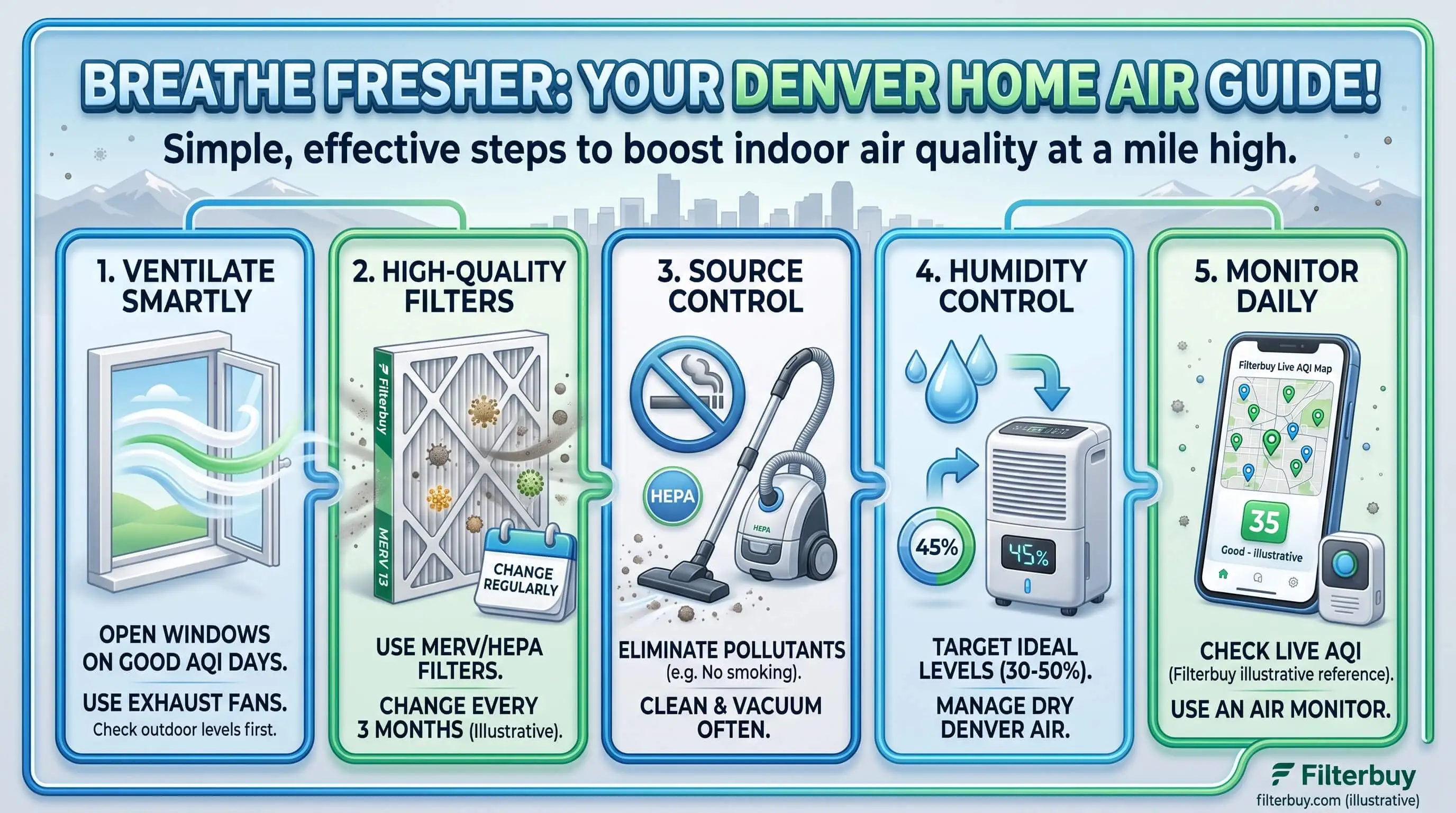
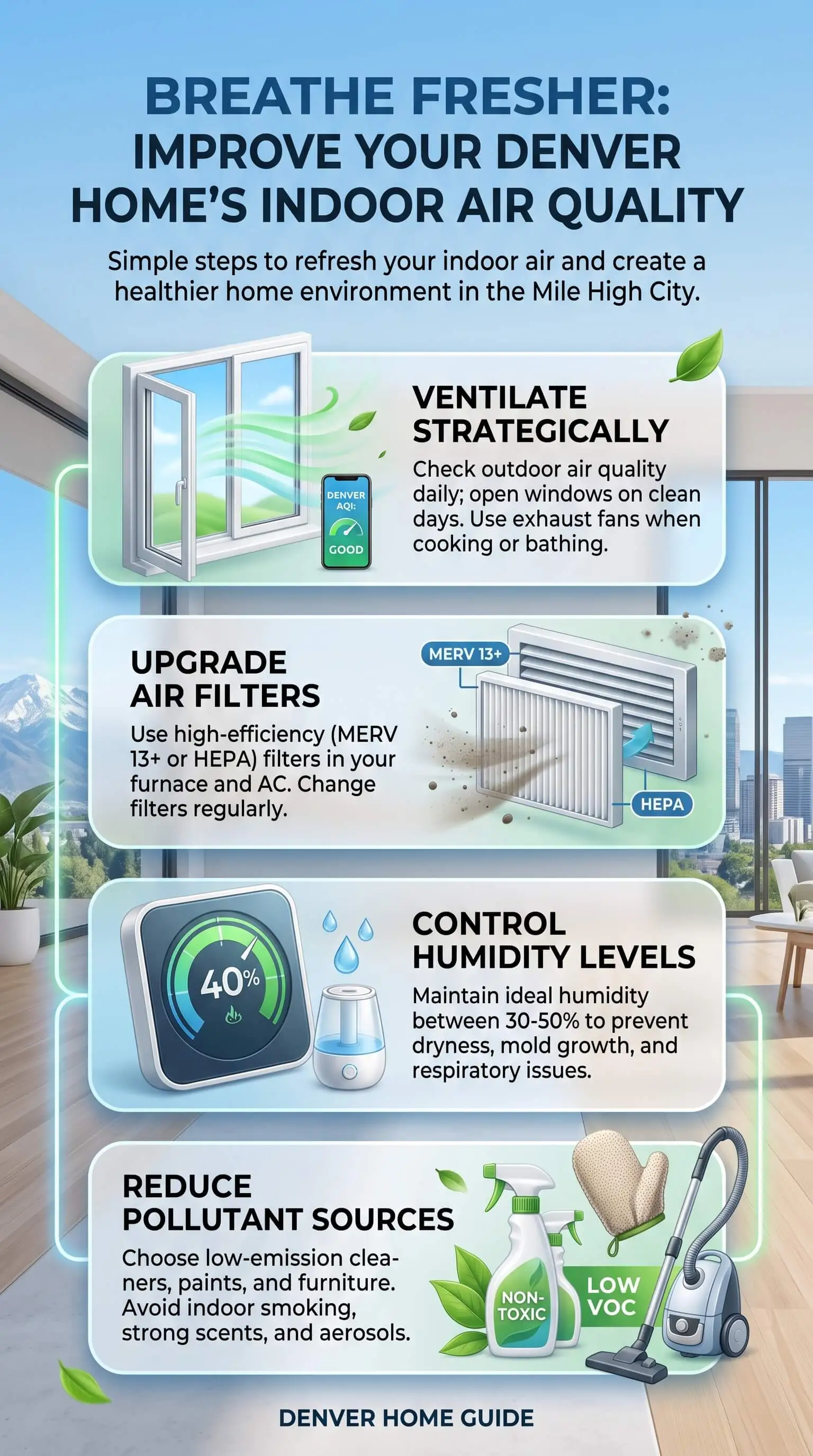
Don’t take your indoor air for granted! You can improve indoor air quality in a Denver home by controlling pollution sources first, ventilating only when outdoor air is clean, filtering what slips inside, and keeping humidity between 30 and 50 percent. The order matters here more than almost anywhere else in the country.
Denver sits at 5,280 feet against the Front Range. Summer ozone, wildfire smoke, winter inversions, and radon-rich soil all take turns working on the air inside your house, because Denver air quality doesn’t stop at the front door. Outdoor air slips in around window frames and through the furnace return. Radon rises from the ground beneath the basement slab.
TL;DR Quick Answers
denver air quality
Denver air quality changes with the season. Ozone is the metro's biggest problem: State of the Air 2026 ranked Denver-Aurora-Greeley 8th worst in the nation, and the Front Range logged 66 days over the federal standard in summer 2026. Wildfire smoke and winter inversions add fine particles that can work their way into your home.
Summer ozone: Ozone builds through sunny afternoons, so mornings and late evenings usually bring the cleanest air for opening windows.
Wildfire smoke: Smoke from fires across the West can push particle levels up within hours. Check the current hour's AQI, not just the daily forecast.
Winter inversions: From October 31 through March 31, Colorado issues a metro forecast every day at 4 p.m. On Action Days, indoor wood burning is restricted across the seven-county area.
Reading the AQI: 0 to 50 is Good and 51 to 100 is Moderate. Above 100, keep windows closed and let filtration do the work.
Don't take your indoor air for granted: Outdoor pollution leaks inside, and radon rises from the soil below. About half of Colorado homes test above the EPA action level for radon, so test yours and run the highest-rated filter your HVAC system can handle.
Top Takeaways
• Sources come first: Test for radon, vent cooking fumes, and follow Action Day burning rules before you spend money on equipment.
• Ventilate by the hour: Check the current AQI, then open windows during cleaner morning or evening hours.
• Filter the rest: Run the highest-rated filter your system can handle, with the fan set to On during smoke.
• Watch the swamp cooler: It pulls outdoor air into the house, smoke and all.
• Balance humidity: Aim for 30 to 50 percent indoors, which keeps you comfortable without feeding mold.
Why Denver Air Quality Follows You Indoors
The American Lung Association’s State of the Air 2026 report ranked the Denver-Aurora-Greeley metro 8th worst in the nation for ozone. Then the Front Range logged 66 days above the federal ozone standard during summer 2026. Add Western wildfire smoke and winter inversions that pin vehicle and furnace exhaust near the ground, and outdoor air has plenty to pass along.
Some of it ends up in your living room. Air leaks in wherever the house isn’t tight, and a swamp cooler or fresh-air intake pulls it in on purpose. Once you seal up for winter, the pollution you create yourself, from the gas range to the fireplace, has nowhere to go. Better indoor air means working both sides of that equation, including proper ductwork installation to help move and distribute air more effectively.
Start With the Sources You Can Control
The EPA ranks the fixes clearly. Removing pollution sources and ventilating with clean outdoor air do the most good, and filtration backs them up. In Denver, start with the three sources below.
Test for Radon Before Anything Else
Radon is a radioactive gas that seeps up from the soil through foundation cracks and crawl spaces. CDPHE reports that roughly half of Colorado homes exceed the EPA action level of 4.0 pCi/L, and a test is the only way to make that invisible problem visible in your own house. The state hands out free test kits. If you already have a mitigation system, retest every two years. Winter makes a smart testing window, since a closed-up house lets radon build.
Follow No-Burn Action Days
From October 31 through March 31, the state posts a metro air pollution forecast every day at 4 p.m. When it is called an Action Day, mandatory restrictions across the seven-county Denver-Boulder area limit indoor burning to approved devices, such as EPA-certified stoves. An open fireplace on one of those nights pushes fine particles into the air your family and your neighbors breathe. Check the forecast before you strike a match.
Vent Cooking and Cleaning Fumes
Every time a gas burner lights, it releases combustion gases, nitrogen dioxide among them. Run a range hood that vents outdoors whenever you cook, and leave it on a few minutes after the pan comes off the heat. For cleaners and paint, go unscented and low-VOC, and save window-open projects for hours when the outdoor reading cooperates.
Ventilate by the Hour, Not the Day
Fresh air dilutes indoor pollution. In Denver, though, timing decides whether you’re diluting it or importing more. Ground-level ozone builds through sunny summer afternoons, which usually makes mornings and late evenings the cleanest hours to open up. Before you crack a window, pull up the live Denver air quality map and read the current hour, not just the day’s forecast.
Swamp coolers deserve extra attention. An evaporative cooler pulls big volumes of outdoor air through wet pads, and on smoke days that means it carries smoke straight inside. Switch it off when smoke rolls in and lean on closed windows and filtration.
Ventilation can move more than fresh air, too. The Home Ventilating Institute points out that exhaust-only ventilation can draw radon up from a crawl space, especially with bath fans, range hoods, and dryers running at once. One more reason to test first.
Filter What Gets Past the Walls
Filtration picks up whatever source control and smart ventilation miss. Use the highest-rated filter your HVAC system can handle, which is MERV 13 in many modern systems. Confirm the fit with your equipment manual or a technician first, since a filter that’s too restrictive can strain an older blower.
Pro Tip: Set the thermostat fan to On instead of Auto during smoke events and winter inversions, and check the filter monthly while they last. Heavy particle loads fill the media fast.
When smoke gets thick, the CDC recommends a clean room. Pick a bedroom with few windows, close it off, and run a portable air cleaner that’s sized for the space and doesn’t produce ozone. Hold off on candles and vacuuming until the air clears. If your ducts are older or leaky, it’s worth reading how ductwork affects indoor air quality too.
Balance Humidity for Mile High Air
Denver’s semi-arid climate leaves winter indoor air bone dry and hard on sinuses and airways. The Asthma and Allergy Foundation of America recommends holding indoor humidity between 30 and 50 percent. That range keeps you comfortable while limiting dust mites and mold. A simple hygrometer will tell you where you stand. If you add a humidifier, clean it on the manufacturer’s schedule so it doesn’t spread mold or mineral dust.
A Seasonal Denver Air Plan
• Spring: Wind-blown dust and tree pollen hit their peak. Keep windows shut on high-pollen afternoons and start the season on a fresh filter.
• Summer: Ozone and wildfire smoke take over. Ventilate early in the day, shut off the swamp cooler when smoke arrives, and keep a spare filter in the closet.
• Fall: Smoke can hang on into October just as fireplace season starts, so book a chimney inspection and bookmark the burn forecast.
• Winter: Inversions and sealed-up houses concentrate pollutants. Run the fan and watch the humidity. It’s also the best season to test for radon.
“In my experience, the Front Range homes that stay cleanest during smoke weeks are the ones with the furnace fan set to On instead of Auto. A MERV 13 filter only cleans air that actually moves through it. On a mild day with the fan on Auto, that filter can sit idle for hours while smoke settles into the bedrooms.”
7 Essential Resources
1. EPA: Air Cleaners and Air Filters in the Home explains how portable air cleaners and HVAC filters work, and why they back up source control and ventilation.
2. AirNow: AQI Basics walks through all six AQI categories and the pollutants behind each reading.
3. Colorado Front Range Air Quality Advisories puts daily forecasts, Action Day alerts, and indoor burning restrictions for the metro area on one page.
4. Denver’s Love My Air Program shares real-time readings from the city’s own sensor network, neighborhood by neighborhood.
5. CDC Wildfire Smoke Factsheet lays out indoor smoke protection step by step, including how to set up a clean room.
6. AAFA: Indoor Air Quality offers practical guidance for allergy and asthma households, from humidity targets to everyday VOC sources.
7. Home Ventilating Institute: Mechanical Ventilation Types compares exhaust, supply, balanced, and energy recovery ventilation, tradeoffs included.
3 Statistics
1. 66 days: Front Range ozone topped the 70 ppb federal standard on 66 days in summer 2026, making it one of the region’s toughest seasons since 2000. Source: Regional Air Quality Council
2. 8th worst: State of the Air 2026 ranked the Denver-Aurora-Greeley metro 8th worst in the nation for ozone, and Jefferson County averaged 29.7 unhealthy ozone days per year. Source: American Lung Association
3. About half: Roughly half of Colorado homes have radon above the EPA action level of 4.0 pCi/L. Source: Colorado Department of Public Health and Environment
Final Thoughts and Opinion
I think a lot of homeowners start in the wrong place. After the first smoky week, they buy an air purifier, when cheaper and quieter fixes would do more for the whole house. The state’s radon test costs nothing, and checking the hourly AQI before you open a window takes seconds. A properly rated filter with the fan set to On will outwork any single-room gadget.
I’d also argue that radon deserves more of your attention than smoke. You can see and smell smoke. Radon gives you nothing to go on, and in Colorado the odds of an elevated reading sit close to a coin flip. Test first, then build the rest of your plan around what you learn.
Frequently Asked Questions
What AQI Is Safe for Opening Windows in Denver?
An AQI of 50 or below falls in the Good range, and that’s a sensible line for airing out the house. Denver air quality can swing hour to hour, so go by the current reading instead of the daily forecast. Once it climbs past 100, keep the windows shut and let filtration carry the load.
Should I Test My Denver Home for Radon?
Yes. CDPHE reports that about half of Colorado homes exceed the EPA action level, and radon levels vary from house to house, even right next door. Free state test kits make it easy. If your home already has a mitigation system, retest every two years to confirm it’s still doing its job.
What Filter Rating Helps Most With Wildfire Smoke?
MERV 13 catches a large share of the fine particles in smoke and fits many residential systems. Check your equipment specs first, since some older blowers struggle with the extra resistance. Then pair the filter with the fan set to On and a portable air cleaner in the bedrooms.
Can I Use My Fireplace on a No-Burn Day?
Generally, only if it’s an approved device such as an EPA-certified stove, or if you hold a primary-heat exemption. From October 31 through March 31, Action Days restrict indoor burning across the seven-county metro, so check the 4 p.m. forecast before you light a fire.
Breathe Easier in Your Denver Home
You’re already the person in your house who keeps things running, and improving the air in your Denver home follows the same kind of order: sources, ventilation, filtration, then humidity. Begin with air ionizer installation, then use a free radon test and a quick look at today’s AQI to guide what you do next.