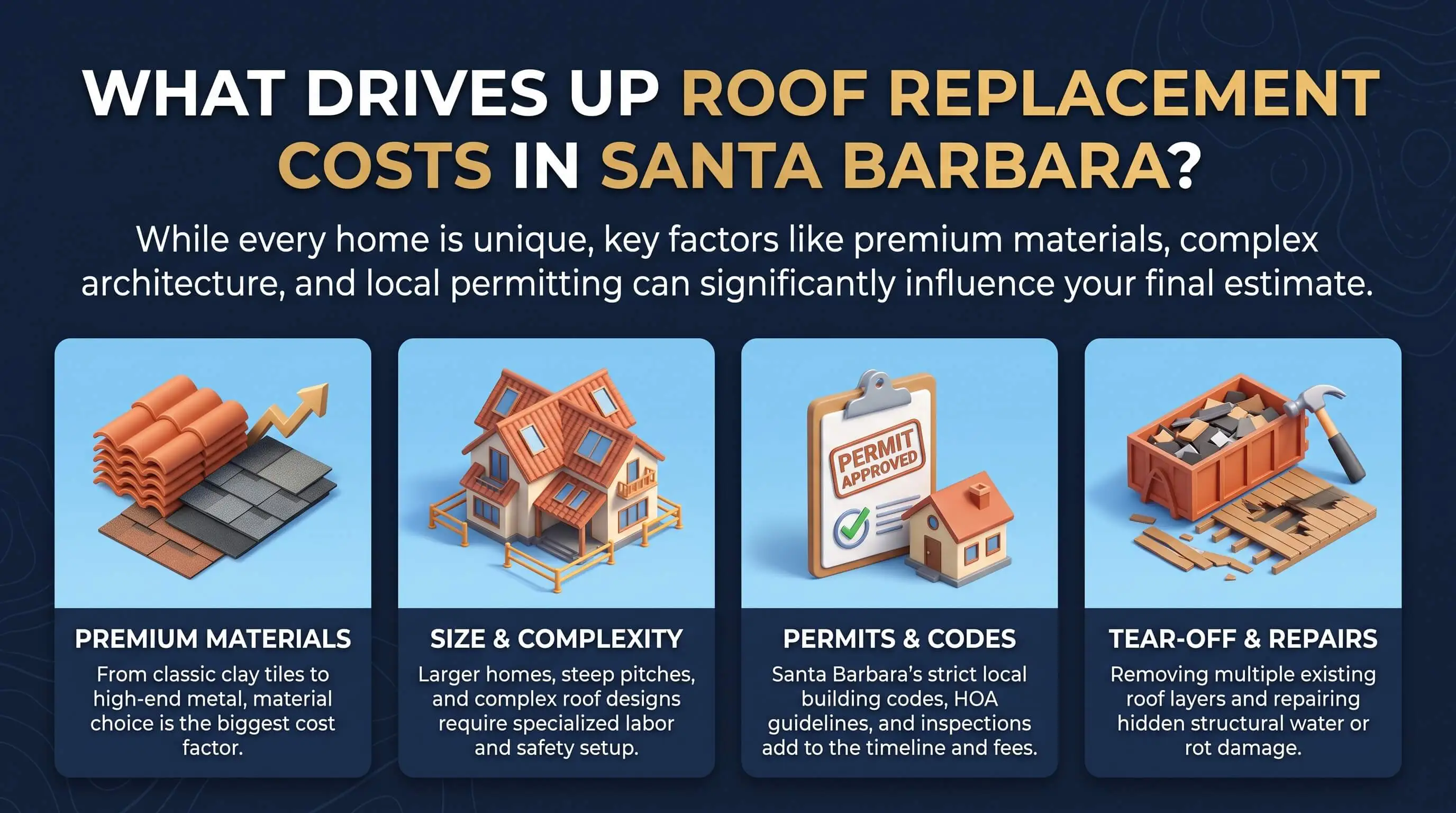
Two roofing quotes for the same Santa Barbara house can land thousands of dollars apart, and both can be honest. The gap usually comes down to material, roof size and pitch, the condition of the decking underneath, fire and coastal requirements, permits, and whatever is bolted to the roof.
Most homeowners only see the shingles or tile. A roof is really a stack of parts working together: decking, underlayment, flashing, vents, and the finish layer on top. Every house here puts those parts together a little differently, so every quote reads a little differently too.
Roof replacement in Santa Barbara has its own local twists that national price guides rarely mention. Clay tile is everywhere. Plenty of neighborhoods sit in wildfire zones, and homes near the water live with salt air all year. Here's how each of those factors moves the price, so you can read an estimate line by line and know which questions to ask.
TL;DR Quick Answers
Roof replacement Santa Barbara
Roof replacement in Santa Barbara typically costs $15,000 to $50,000 for an average-sized home. Most projects take three to five days. The final price depends on the material, the size and pitch of the roof, and what the crew finds under the old roof.
Material sets the range: Asphalt shingles are the budget option. Clay tile and slate cost the most, and clay tile can last 50 years or longer.
Local rules add cost: Fire hazard zones may require Class A roof assemblies, and homes near the coast need corrosion-resistant flashing and fasteners.
Hidden repairs are common: Soft or rotted decking only shows up during tear-off, so ask in advance how deck repairs will be priced.
Permits apply: A full replacement in the City of Santa Barbara generally needs a building permit and a final inspection.
Get it in writing: Ask for a clear, itemized estimate, check the roofer's CSLB license, and compare workmanship warranties.
Top Takeaways
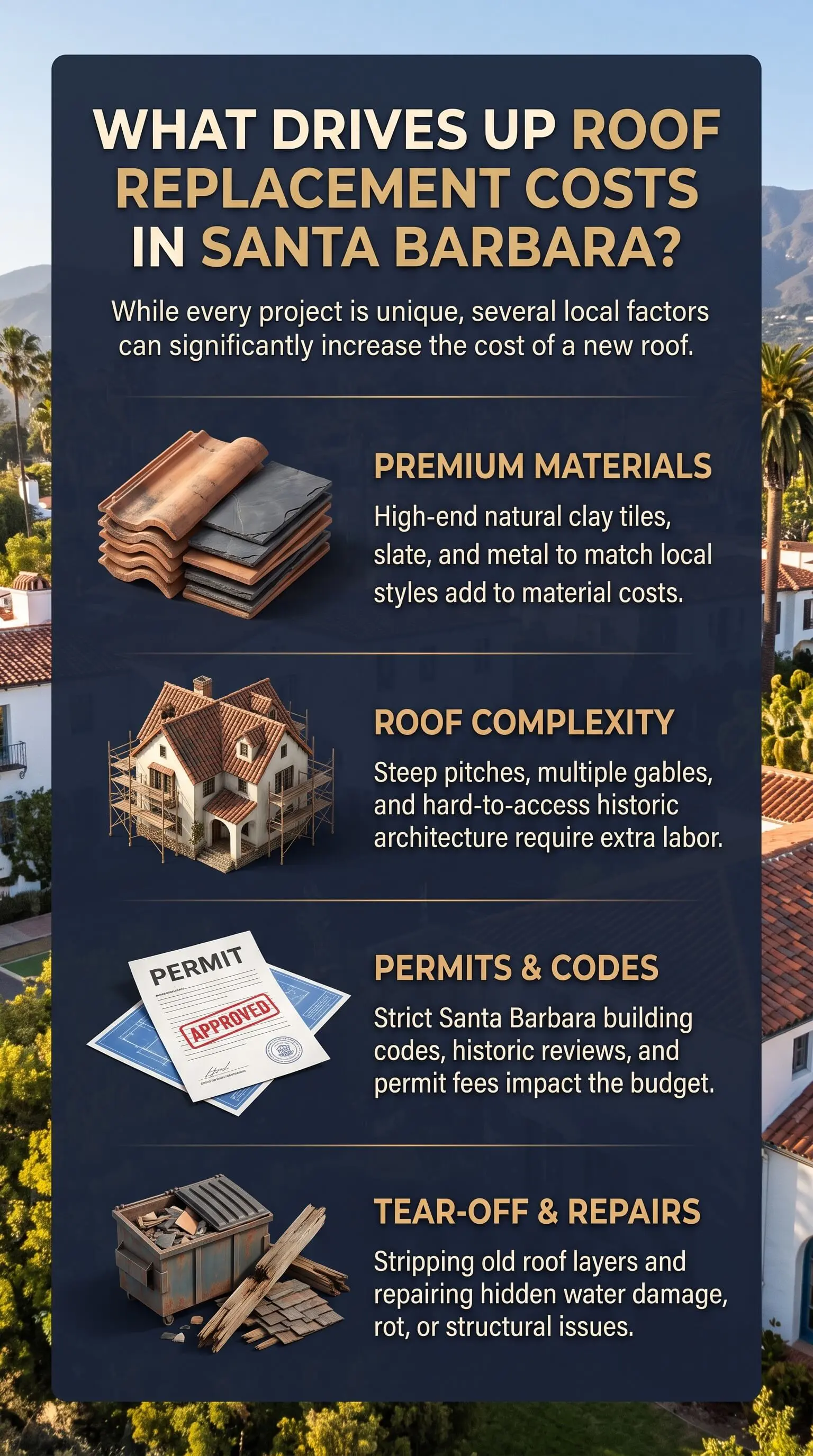
Material moves the price most. Clay tile and slate cost the most, asphalt the least.
Bigger, steeper, more complex roofs take more labor, especially with valleys, dormers, and skylights.
Rotted decking under the old roof is the most common surprise cost.
Fire zones and salt air can call for Class A assemblies and corrosion-resistant metal.
Permits, HOA approvals, and historic review add time and paperwork.
Rooftop HVAC units, flues, and vents have to be moved or re-flashed, so plan both projects together.
Which Roofing Materials Raise the Price Most?
Material moves the number more than anything else. Clay tile and slate sit at the top because they cost more per square, install slowly, and need crews who know how to handle heavy pieces that crack if you set them wrong.
That hits Santa Barbara harder than most places. So many homes here are Spanish, Mediterranean, or historic in style that clay tile is often the only material that fits the house and the street, and sometimes the only one the HOA will approve.
Asphalt shingle: 20 to 35 years and budget-friendly. Common on ranch, traditional, and newer homes.
Flat roofing (TPO, PVC, torch down): 15 to 30 years and mid-range. Suits modern homes, additions, and low-slope roofs.
Concrete tile: 40 to 50 years and mid-range. Popular on Mediterranean and modern homes.
Synthetic slate, shake, or tile: 40 to 50 years and mid-range. Works on coastal homes of any style.
Clay tile: 50+ years and premium. The classic choice for Spanish, Mediterranean, and historic homes.
Natural slate: 75+ years and premium. Best for historic and estate homes.
Weight is the cost people forget. Going from shingles to tile can mean a structural check first, and sometimes reinforcement. Still, a roof that lasts twice as long often costs less per year once you do the math.
How Do Roof Size, Pitch, and Design Change the Cost?
Roofers price by the square, which is 100 square feet of roof surface. Not floor space. A 2,000-square-foot house with deep eaves and a steep pitch can carry far more roof than the floor plan suggests.
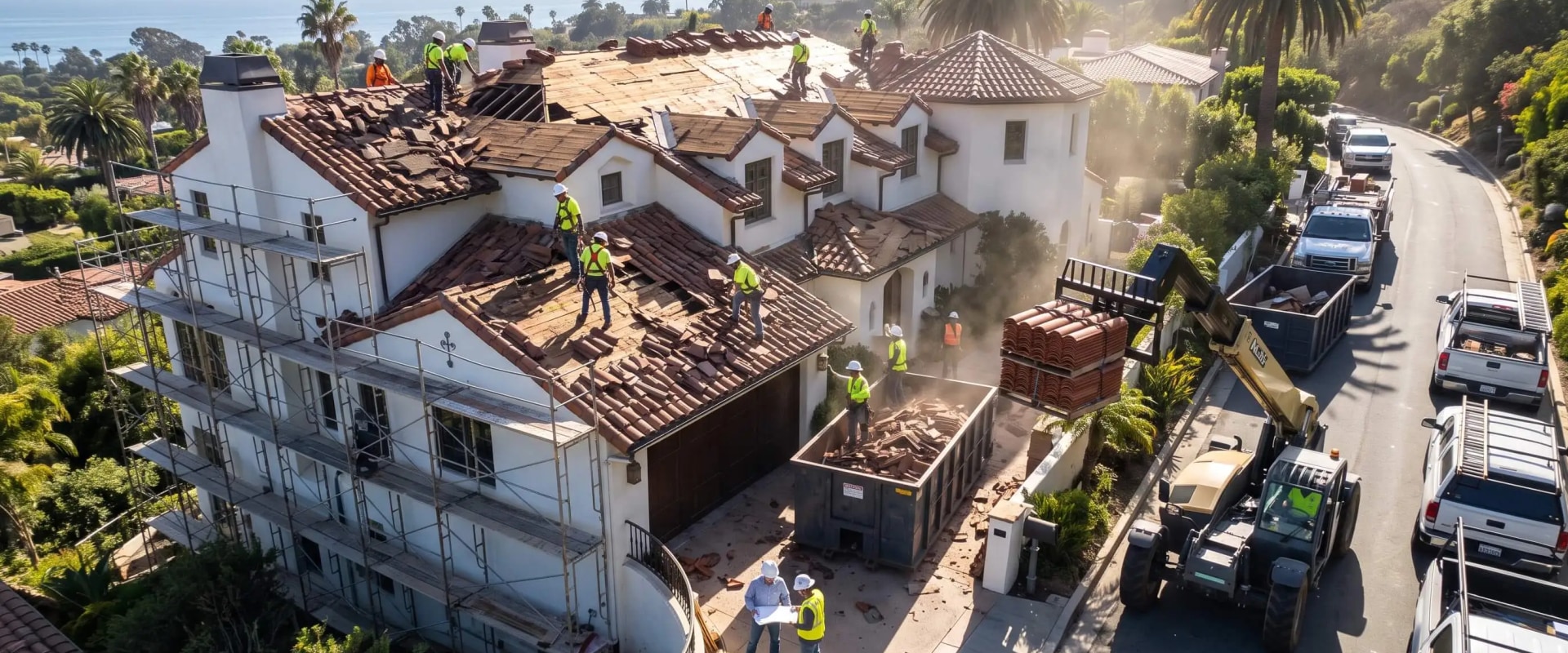
Steep roofs slow everything down. Crews need harnesses, roof jacks, and more time per square. Design adds up as well:
Hips and valleys mean more cutting and more flashing
Dormers, skylights, and chimneys each need to be sealed by hand
Two- and three-story homes take longer to load and work safely
Hillside lots and tight driveways make deliveries and debris haul-off harder
That's why two houses with matching floor plans can get very different quotes.
What Hidden Repairs Show Up During Tear-Off?
Rotted decking is the surprise we hear about most, and nobody can confirm it until the old roof comes off. A slow leak around a vent pipe can soften plywood for years before a stain ever shows up on a ceiling.
Other findings that push the price up:
Two or more old layers that all have to be stripped and hauled away
Underlayment that failed and let water reach the deck
Rusted or poorly sealed flashing at walls, chimneys, and pipes
Older plank decking that needs new sheathing before tile or shingles can go down
A good estimate tells you up front how deck repairs will be handled and priced. If you're comparing options for roof replacement in Santa Barbara, ask for a clear written quote that includes deck inspection and repair, so the price doesn't change halfway through the job.
How Do Fire Zones and Coastal Air Affect Roof Replacement in Santa Barbara?
A lot of Santa Barbara County sits in designated fire hazard areas, and roofs there have to meet fire-resistance standards that add to material and labor costs. A Class A fire-rated assembly gives the highest protection, and ember-resistant vents may be part of the job too.
Clay tile, concrete tile, slate, and many asphalt shingles can all reach Class A when a crew installs them as a rated assembly. The details underneath matter just as much as the tile, including the underlayment, the edge metal, and how the open ends of tile are closed off so embers can't blow in.
Near the ocean, the problem is salt. It eats through cheap fasteners and flashing faster than most people expect. Corrosion-resistant metal costs more on day one, and it's what lets a 50-year tile roof actually reach 50 years.
How Do Permits, HOAs, and Historic Rules Add Cost?
A full roof replacement in the City of Santa Barbara generally needs a building permit and a final inspection. Both take fees and scheduling time, and they belong in the estimate.
Then there's a local review. HOAs in Montecito, Hope Ranch, and private communities often limit which materials and colors you can use. Older and landmark homes may go through historic or coastal review. A roofer who handles this paperwork every week can keep things moving, but the extra time still shows up in the price.
How Do Rooftop HVAC Equipment and Vents Affect Roofing Costs?
Anything that sits on the roof or passes through it has to be worked around, pulled, or resealed. On a lot of homes, that means heating and cooling equipment.
Rooftop condensers or package units that have to be disconnected, lifted, and reset
Furnace flues and exhaust vents that need new flashing
Attic ductwork that has to be protected during tear-off
Attic ventilation upgrades that help the new roof and the AC system run cooler
If new HVAC equipment is on your list too, plan the two jobs together so you're not paying to cut and seal the roof twice. For the other half of that budget, see this guide to HVAC replacement costs and whether your existing ductwork can stay.
How Can You Keep a Roof Replacement Budget Under Control?
Your roof's pitch and fire zone are fixed, but how clearly the work gets written up is up to you.
Ask for an itemized estimate that separates materials, labor, tear-off, and disposal
Ask how deck repairs are priced, per sheet or per square foot
Look up the contractor's California license on the CSLB site
Compare workmanship warranties, not only manufacturer warranties
Book outside the rainy season when you can
The lowest bid isn't always the lowest final bill. A clear scope is what keeps change orders off your invoice.
"Most of the surprises on a Santa Barbara reroof sit under the tile. On older homes, especially ones that went through a few wet winters with a small leak nobody caught, we pull back the first few rows and find soft decking around chimneys, skylights, and old vent pipes. We'd rather show you that on paper before the job starts than call you about it halfway through. Once people see where the money actually goes, the higher quote usually turns out to be the honest one."
7 Essential Resources
Bookmark these before you sign anything. Each one lets you check a quote, a rule, or a contractor yourself instead of taking someone's word for it.
CSLB Check a License: Type in a roofer's license number and see whether it's active, plus any complaint disclosures. It takes about a minute.
Cal Fire Fire Hazard Severity Zone Maps: The State Fire Marshal's maps show whether your address is rated moderate, high, or very high, which shapes the roofing assembly you'll need.
Cal Fire Home Hardening Guide: Cal Fire calls the roof one of the most vulnerable parts of a house in a wildfire and explains what a Class A covering, drip edge, and protected vents do.
City of Santa Barbara Building Permit Forms and Applications: When a permit is required, how to apply through Accela, and what passing a final inspection means.
City of Santa Barbara On-Demand Permits: The city issues instant online permits for qualifying like-for-like reroofs and single-family HVAC replacements. Handy if both projects are on your list.
City of Santa Barbara Historic Resource Design Guidelines: Roofs: For older homes, this chapter lays out what the city expects for roof forms, terra cotta tile, chimneys, and vents.
NRCA Consumer Information: The National Roofing Contractors Association's plain guidance on vetting a roofer, reading warranties, and comparing roof coverings.
3 Statistics
These numbers help you judge a local quote, and the last one is a good reminder that a new roof tends to pay you back.
$15,000 to $50,000: That's the typical range Quality Roofing gives for average-sized Santa Barbara homes. Material and project complexity decide where a house falls.
About $16,600 for asphalt alone: HomeAdvisor lists an average of $16,624 for asphalt shingle projects in Santa Barbara, with most falling between $13,593 and $20,666. Tile, slate, and fire-rated upgrades sit above that.
37 percent of Realtors recommend it: In the 2025 Remodeling Impact Report from the National Association of Realtors and NARI, 37 percent of Realtors told sellers to put on a new roof before listing. Homeowners who did it gave the project a perfect Joy Score of 10.
Final Thoughts
The high quote usually has a reason behind it. Clay tile, Class A assemblies, salt-resistant metal, and permit or HOA review all cost money, and none of them show up in a national average built around asphalt shingles. When a homeowner here compares a local tile estimate to a number from a pricing website, the local quote will look high every time.
Read the line items before you look at the total. The best estimates for roof replacement in Santa Barbara spell out the tear-off, the deck repair policy, the underlayment and flashing, and anything on the roof that has to move, including HVAC equipment. Once those are on paper, comparing two contractors gets a lot easier.
Our honest advice is to spend on the parts you'll never see. Decking, underlayment, and flashing decide how long the tile or shingles on top actually last.
Frequently Asked Questions
How much does roof replacement cost in Santa Barbara?
For an average-sized home, local contractor pricing runs from about $15,000 to $50,000. Asphalt shingles sit near the bottom of that range. Clay tile, slate, steep pitches, and fire-rated upgrades push toward the top, and deck repairs or permit requirements can shift it again. Ask for an itemized written estimate so you can see exactly where your number comes from.
Why are tile roofs more expensive to replace?
Clay and concrete tile cost more per square, weigh far more than shingles, and take an experienced crew longer to set. They also need the right underlayment, battens, and flashing underneath. The payoff is lifespan. Clay tile can last 50 years or more, which spreads the cost over a much longer stretch.
Do I need a permit to replace my roof in Santa Barbara?
Yes. Inside the City of Santa Barbara, a roof replacement generally needs a building permit and a final inspection. Simple like-for-like reroofs may qualify for the city's on-demand online permit. If your home is in the county, an HOA, or a historic district, expect extra review.
Can a new roof go over the old one?
Sometimes, though not often here. Codes cap how many layers a roof can carry, and an overlay hides the decking, which is where most problems start. Tile roofs, fire-rated assemblies, and older roofs with soft spots usually call for a full tear-off. It costs more up front and gives the new roof a solid base.
Should I replace my roof before installing new HVAC equipment or solar?
If the roof is near the end of its life, yes, do it first. Rooftop units, flues, and solar mounts all mean holes that have to be sealed. Replacing the roof first, or scheduling both jobs together with top-rated HVAC installation pros, saves you from paying to remove and reinstall equipment twice.
Get a Clear Roof Replacement Estimate
A better roof starts with an honest look at what's on top of your house and what's underneath it. Call a licensed local roofer for a free, itemized estimate that covers materials, tear-off, deck repairs, permits, and any equipment on the roof. With every cost written down, you can pick the right roof for your home and stop guessing.