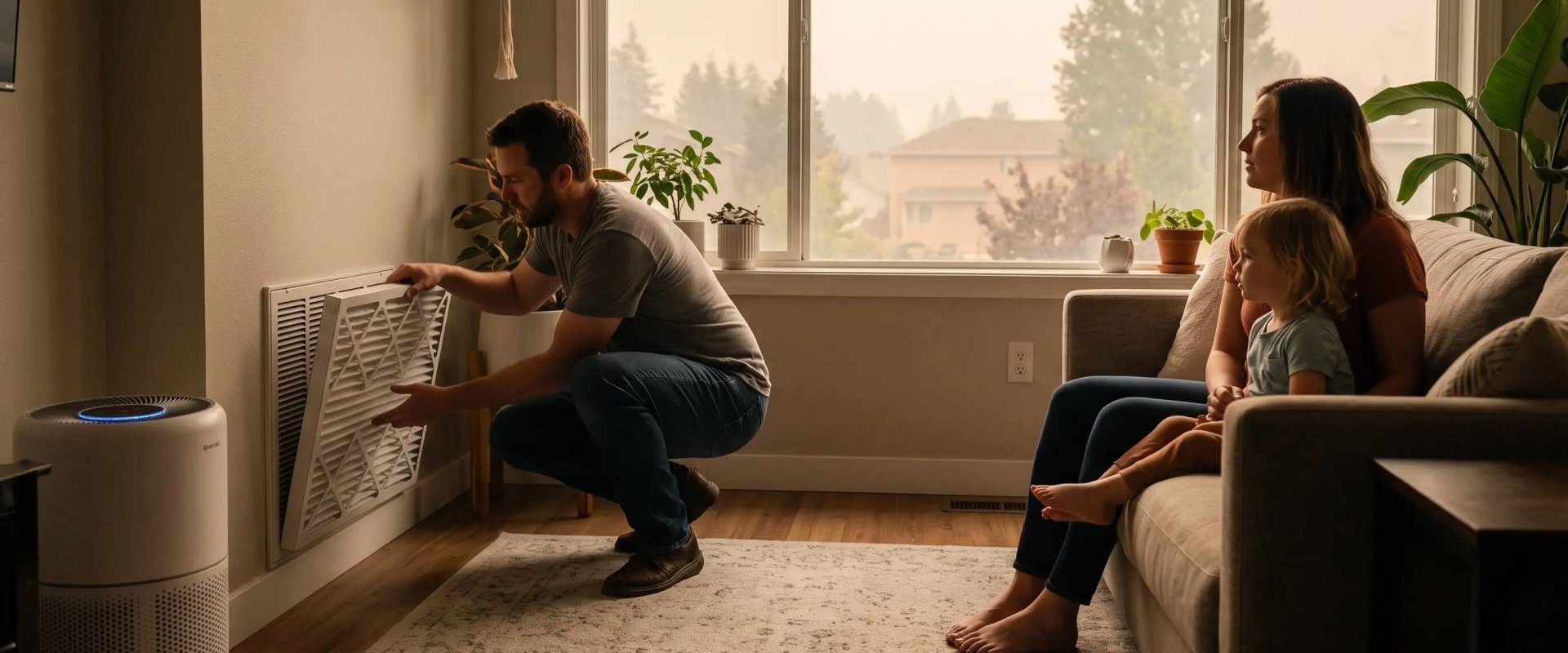
When a smoke advisory pings your phone, the filter already sitting in your return vent decides how much of that haze ends up in your family's bedrooms. Most people don't think about it until the house starts to smell like a campfire.
Don't take that filter for granted! Smoke doesn't wait politely at the front door. Its finest particles squeeze through the gaps around windows and door frames and any fresh-air intake your system has, then ride your ductwork into every room you close up to stay safe.
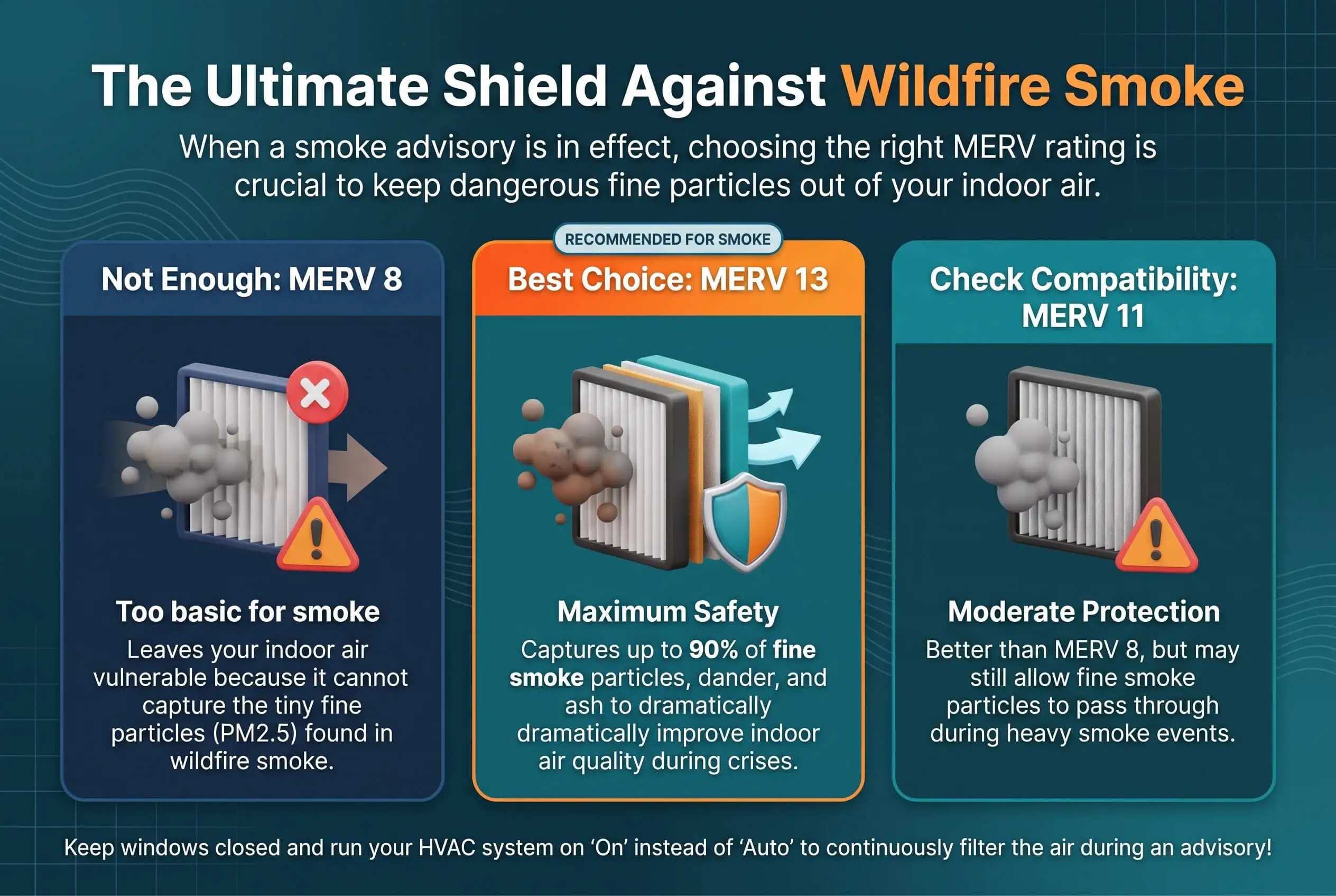
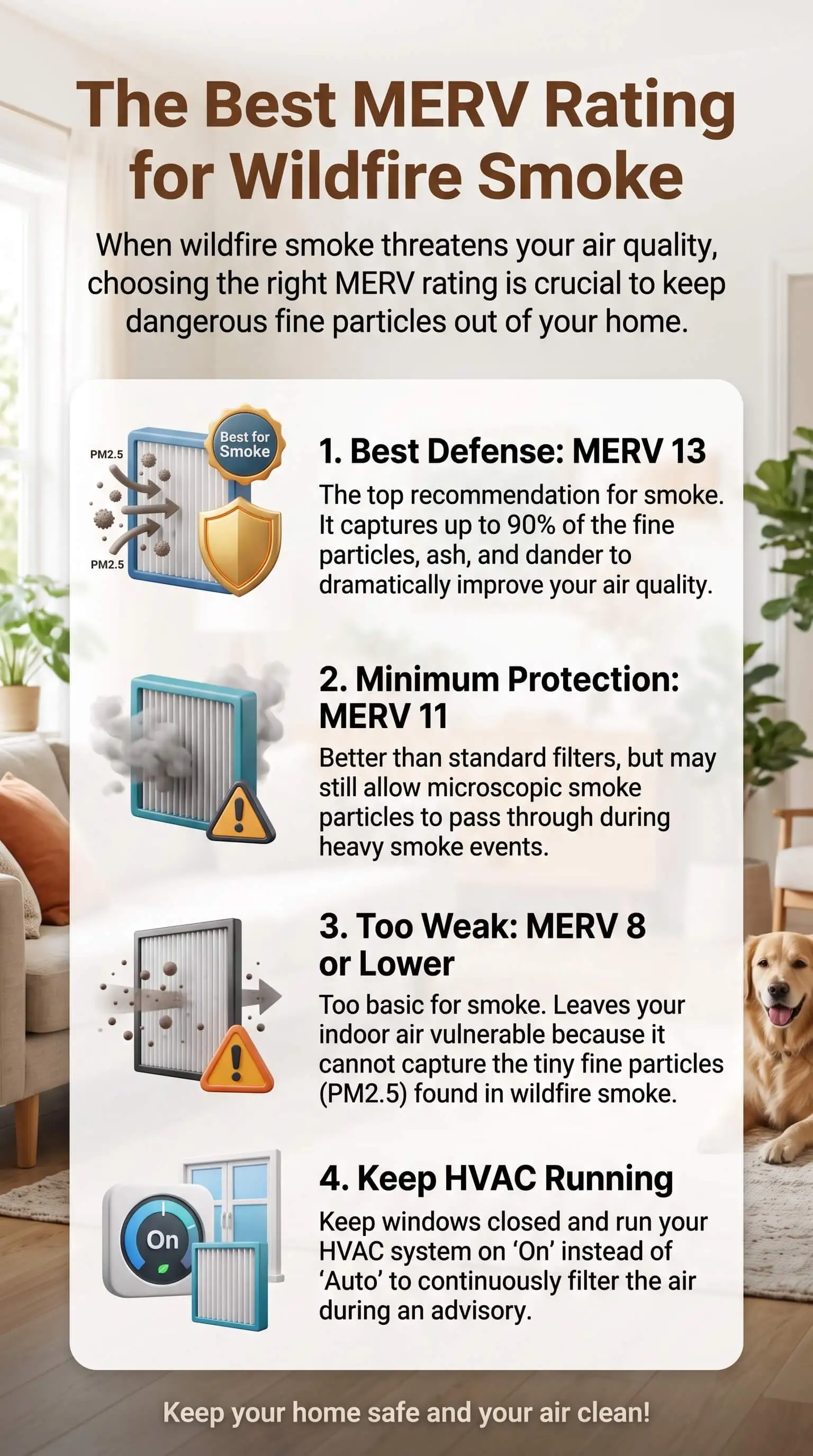
Use a MERV 13 filter, or the highest rating your HVAC system can handle without starving its airflow. The EPA draws that line for smoky periods, and once you see where smoke lands on the MERV rating chart, the reason makes sense.
Florida's wildfire season peaks from April through June, so if you live here, settle this before the next burn ban instead of in the middle of one.
TL;DR Quick Answers
MERV rating chart
A MERV rating chart shows how well an air filter captures particles on ASHRAE’s 1 to 16 scale. Each rating has to meet a minimum capture rate in three particle size ranges, so the number is a floor rather than a best case. For wildfire smoke, look at the 0.3 to 1.0 micron range.
MERV 1 to 4: basic equipment protection, catching under 20% of particles from 3.0 to 10.0 microns.
MERV 8: at least 70% of 3.0 to 10.0 micron particles and 20% of 1.0 to 3.0 micron particles, with no requirement in the smoke range.
MERV 11: adds at least 20% capture of 0.3 to 1.0 micron particles, a solid step up for pets and finer dust.
MERV 13: at least 50% of 0.3 to 1.0 micron particles, the rating the EPA points to when wildfire smoke moves in.
MERV 14 to 16: 75% to 95% or more in the finest range, built for commercial blowers.
Before you upgrade: check your system’s maximum rated MERV, because denser media adds airflow resistance.
Top Takeaways
The EPA points to MERV 13 for wildfire smoke, or the highest rating your system can handle.
Most smoke particles sit between 0.3 and 1.0 microns, a range where MERV 8 has no capture requirement at all.
MERV 11 is the sensible fallback when your system can't handle MERV 13's airflow resistance.
Switching the fan to On and checking the filter every few days counts as much as the rating on the frame.
A portable air cleaner in one clean room covers what a whole-home filter can't reach alone.
How to Read the MERV Rating Chart for Wildfire Smoke
MERV is short for Minimum Efficiency Reporting Value. ASHRAE built the 1 to 16 scale so you can compare filters on the same terms, and every rating has to clear a minimum capture rate in three particle size ranges to earn its number. That word "minimum" is doing real work. A filter's MERV reflects its weakest showing across the whole test, so you're looking at a floor you can count on rather than a best-case number.
A full MERV rating chart lays out all 16 levels side by side. For smoke, you only need to watch the size bands it's built on.
E3, 3.0 to 10.0 microns: pollen, household dust, and mold spores, which most pleated filters handle well.
E2, 1.0 to 3.0 microns: finer dust and the larger smoke particles. Every rating from MERV 8 up has to catch a set share here.
E1, 0.3 to 1.0 microns: where most smoke lives, and only MERV 11 and higher carry any capture requirement in this band.
Where Smoke Particles Land on the Scale
The EPA calls fine particles the biggest health threat in wildfire smoke, since they're small enough to travel deep into your lungs. A lot of smoke measures under one micron. That puts it right in the E1 band, and it's why the haze you can see through the window is only the visible edge of a much finer cloud you can't.
MERV 8 vs MERV 11 vs MERV 13 for Smoke
MERV 8 catches at least 70% of particles from 3.0 to 10.0 microns and has no requirement at all in the smoke range. It's a solid everyday dust filter and the wrong pick for an advisory.
MERV 11 has to capture at least 20% of particles between 0.3 and 1.0 microns. That's a genuine step up and a sensible fallback when your system can't take more.
MERV 13 captures at least 50% of 0.3 to 1.0 micron particles and 85% of those between 1.0 and 3.0 microns, which is why the EPA points to it when smoke moves in.
MERV 14 through 16 go higher still, but manufacturers design them for commercial blowers built to push air through denser media.
If you'd like to run MERV 13 year-round, this guide to selecting MERV 13 home air filters walks through the everyday side of that choice.
Can Your HVAC System Handle MERV 13?
Denser media traps more, and it also pushes back harder on the air moving through it. HVAC techs call that resistance pressure drop. Once it climbs past what your blower was built for, the system runs longer to move the same air, your evaporator coil can get too cold, and a smoke-clogged filter piles onto both problems.
Check these before you upgrade:
Your manufacturer's documentation. Look for a maximum MERV rating or a rated pressure drop for your air handler.
Filter depth. A 4-inch filter spreads its media over far more surface than a 1-inch one, so it reaches MERV 13 with less strain on the blower. Deeper media filters such as the 20x25x4 exist for exactly this reason.
Fit. The filter should sit snug in the slot with no gaps around the frame, and a correctly sized standard filter keeps smoke from sneaking past the edges.
Then watch the system for a few days. Weaker airflow at the vents, longer run cycles, or frost on the refrigerant lines all point the same way, so drop back to MERV 11 and ask a licensed HVAC technician what your system can safely run.
What to Do the Day an Advisory Goes Out
Slide in a fresh MERV 13 filter with the airflow arrow pointing toward the blower.
Switch the thermostat fan from Auto to On. The EPA's wildfire and indoor air guidance recommends it, because air keeps moving through the filter even between heating and cooling cycles.
Close the fresh-air intake or switch to recirculate, if your system has either option.
Keep windows and doors shut. Hold off on candles, frying, and vacuuming unless your vacuum has a HEPA filter.
Turn one room, ideally a bedroom, into a clean room with a portable air cleaner that doesn't produce ozone.
Pull the filter every few days and look at it. Once it's gray or dark, swap it, whatever the calendar says.
"Every smoke season, I pull MERV 13 filters after one heavy week that look like they've been in for three months. That's the filter doing exactly what it should. The same dense media that grabs fine smoke also chokes airflow sooner, though, so I tell homeowners to check theirs every few days during an advisory and not wait for the usual reminder."
7 Essential Resources
Air Filter MERV Ratings, Charts and Scales: the full MERV rating chart linked earlier on this page, with capture rates for every level from 1 to 16.
EPA Indoor Air Filtration Fact Sheet: how to pick HVAC filters and portable air cleaners for smoke.
CDC: People at Higher Risk From Wildfire Smoke: who should take extra care when an advisory goes out.
California Air Resources Board Certified Air Cleaners: a searchable list of air cleaners tested for low ozone output.
ASHRAE Wildfire Response Resources: engineering guidance for keeping smoke away from the people inside a building.
American Lung Association: Wildfires: practical health advice for staying safe indoors while smoke hangs around.
AHAM: About Air Cleaners: how a room air cleaner differs from whole-home filtration.
3 Supporting Statistics
Up to 90% of wildfire smoke can be PM2.5, the fine particle class MERV 13 is built to catch. National Air Filtration Association
1,500+ wildfires and 54,000+ acres burned in Florida by early April 2026, right as a peak season running April through June got started. Florida Division of Emergency Management
0.55 vs 0.22 was the indoor-to-outdoor PM2.5 ratio researchers measured in one smoke-affected home, first with a MERV 13 filter alone and then with a portable air cleaner added. Pollutants study via PubMed Central
Final Thoughts and Opinion
Here's where I land. MERV 13 is the right number for most homes during a smoke advisory, but a number printed on a frame doesn't protect anybody on its own. That single-home study shows it plainly. The MERV 13 filter by itself held indoor smoke to roughly half of what was outside, and adding a room air cleaner pushed that down to about a fifth.
Honestly, I'd rather see a snug MERV 11 that gets checked every few days than a MERV 13 jammed in crooked and forgotten. Fit, fan setting, and how quickly you replace a loaded filter decide how much of that rating actually reaches your lungs. Stash a spare before the season starts. That one small habit keeps the haze outside where it belongs and lets your family breathe easier inside.
Frequently Asked Questions
Is a MERV 13 Filter Safe for My Furnace?
For most home systems, yes, as long as it fits snugly and you replace it often. Manufacturers designed some older or undersized blowers around lower-resistance media, though. Check your documentation for a maximum rating. If airflow drops or run times stretch after the swap, go back to MERV 11 and call a technician.
Can I Use MERV 13 Only During Smoke Season?
Yes. You can run MERV 8 or MERV 11 most of the year and switch to MERV 13 once advisories start. Keep a correctly sized MERV 13 on hand before the season begins, since filter demand tends to jump the same week smoke shows up.
How Often Should I Change My Filter During a Smoke Advisory?
Check it every few days and replace it as soon as it looks gray or dark. Smoke loads a filter much faster than everyday dust, so the usual one to three month schedule doesn't apply during an advisory. A clogged filter chokes airflow and lets more particles slip around the media.
Is MERV 13 as Good as HEPA for Wildfire Smoke?
No. HEPA media catches a bigger share of fine particles, but it creates more resistance than most home HVAC systems can handle. The practical setup pairs MERV 13 in your central system with a HEPA portable air cleaner in the room where you sleep or spend the most time.
Will Running the Fan on Smoky Days Raise My Energy Bill?
Yes, running the fan nonstop uses more electricity, and how much depends on your blower motor. Variable-speed blowers typically draw less than older single-speed motors. For the few days an advisory lasts, cleaner air wins that trade-off, and you can flip the fan back to Auto once the smoke clears.
Have the Right MERV Rating in Place Before the Next Smoke Advisory
The best MERV rating for a wildfire smoke advisory is the one already sitting in your filter slot when the haze rolls in. Measure that slot, confirm what your system can handle, and keep a spare MERV 13 set aside so you're ready to protect your home and family when smoke season arrives.